For EPS foam shipper-wall acceptance, record fracture appearance, dry molded-part weight and liquid-water observations separately. Start with the inspection question, choose the corresponding check, and record the acceptance criterion before releasing the lot.
Use this guide to organize incoming inspection alongside your protective packaging requirements:
- For bead fusion, retain a fracture photograph and a ruptured-particle percentage estimate.
- For molding density, identify the part, its drying condition and the density definition requested.
- For water uptake, identify the exposure method and keep the observed result with its test conditions.
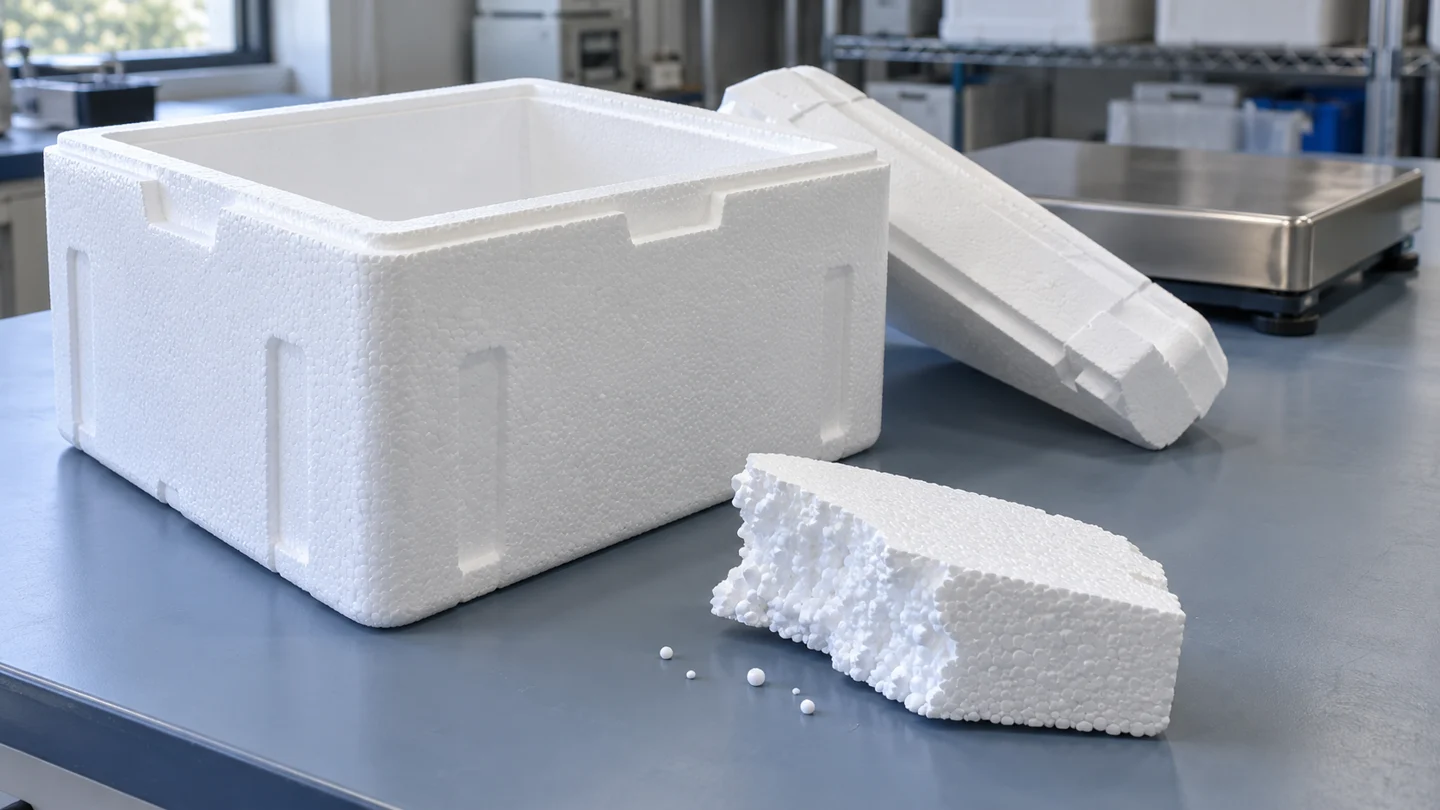
Read the fracture for expanded polystyrene bead fusion
Use a broken-open sample for the fracture assessment. In BASF’s Styropor molded-part inspection: The fracture pattern provides information about particle fusion.
A broken-open foam surface is used to estimate ruptured versus undamaged particles as a percentage.
Lifoam’s description distinguishes the fracture locations:
Low fusion is characterized by failure at the bead-to-bead interface.
High fusion is characterized by fracture within the foam particles.
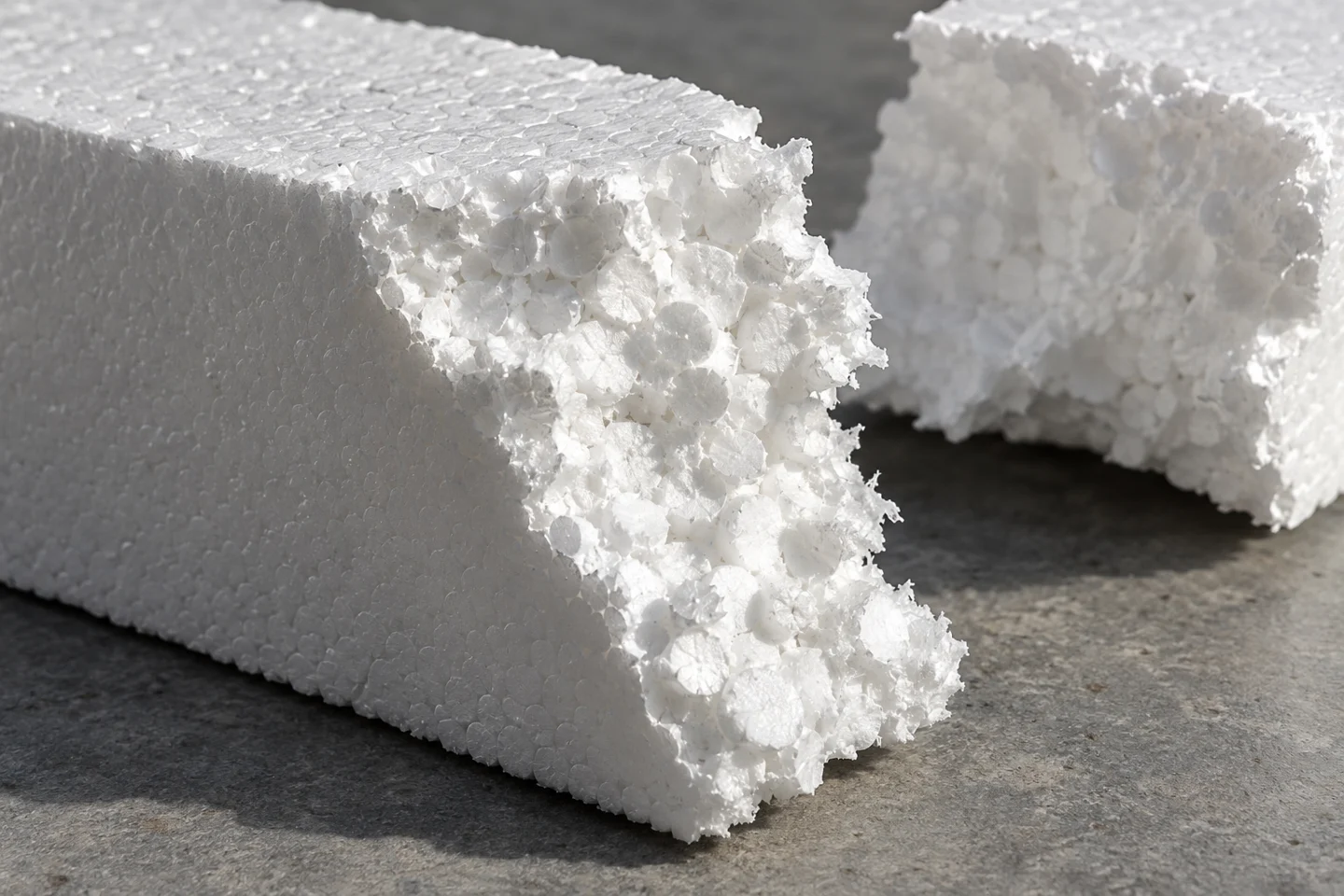
Record the sampling location, assessment method, estimated ruptured-particle percentage and agreed acceptance criterion. Include the photograph with the result so the next inspection can use the same assessment approach.
For the mechanical context in BASF’s Styropor discussion: Tensile strength is particularly sensitive to bead-fusion variations.
Reduced fusion diminishes deflection at break and makes the material more brittle.
Keep the fracture observation and release decision in separate worksheet fields, comparing the observed ruptured-particle percentage directly against the part drawing’s minimum fusion threshold before releasing the molded lot.
Set up an EPS cooler density test
Start with the part identity and drying condition. In BASF’s molded-part inspection: Molded-part weight is used to check the constancy of bulk density.
Molded parts are weighed after drying.
Control charts help provide an overview of production quality.
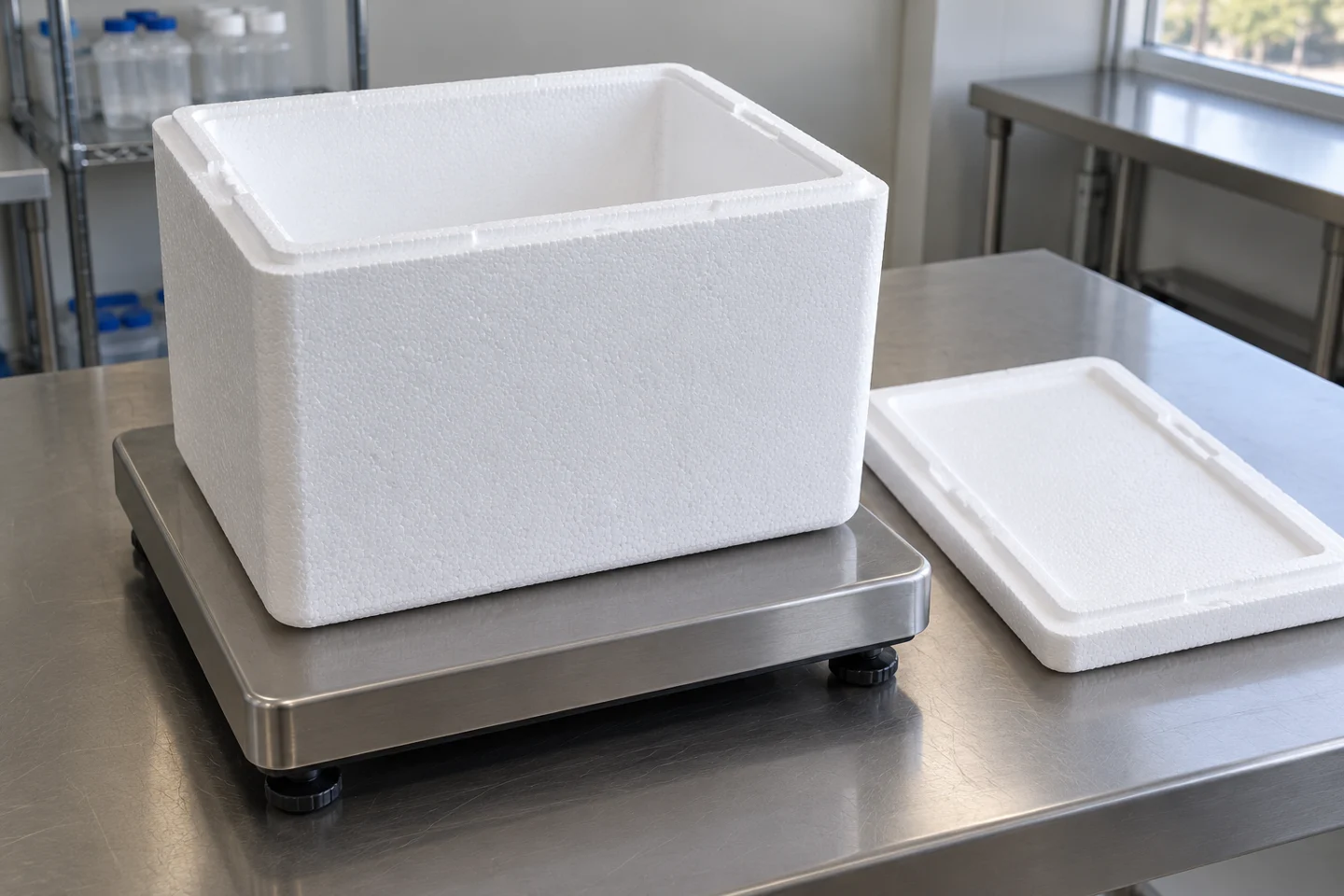
For a density report, specify the definition. Under ISO’s cellular-material density definition:
Apparent overall density is sample mass per unit volume, including molding skins.
ASTM’s density-method scope distinguishes the skin condition:
Overall density includes forming skins; core density removes them.
Use sample mass divided by sample volume for apparent overall density, retaining the molding skins. Record the volume source alongside the mass, and specify the component represented by each entry.
BASF describes a separate preexpansion check:
Loose pre-expanded bead bulk density can be checked by weighing a fixed volume.
Label a report as a molded-part measurement or a loose-bead measurement. For the box drawing and assembly record, continue with the insulated shipping box guide.
Investigate EPS water absorption and leakage
Choose the water question before choosing the check. BASF describes liquid contact with Styropor as follows: Styropor foams can absorb moisture in direct contact with water.
Water can penetrate through the tiny channels between fused beads.
Water uptake depends on raw-material processing behavior and processing conditions, especially expansion.
For packaging required to retain liquid, BASF’s inspection uses a colored-liquid check:
Packaging or moldings required to be impermeable to liquid are sampled and filled with colored liquids for testing.
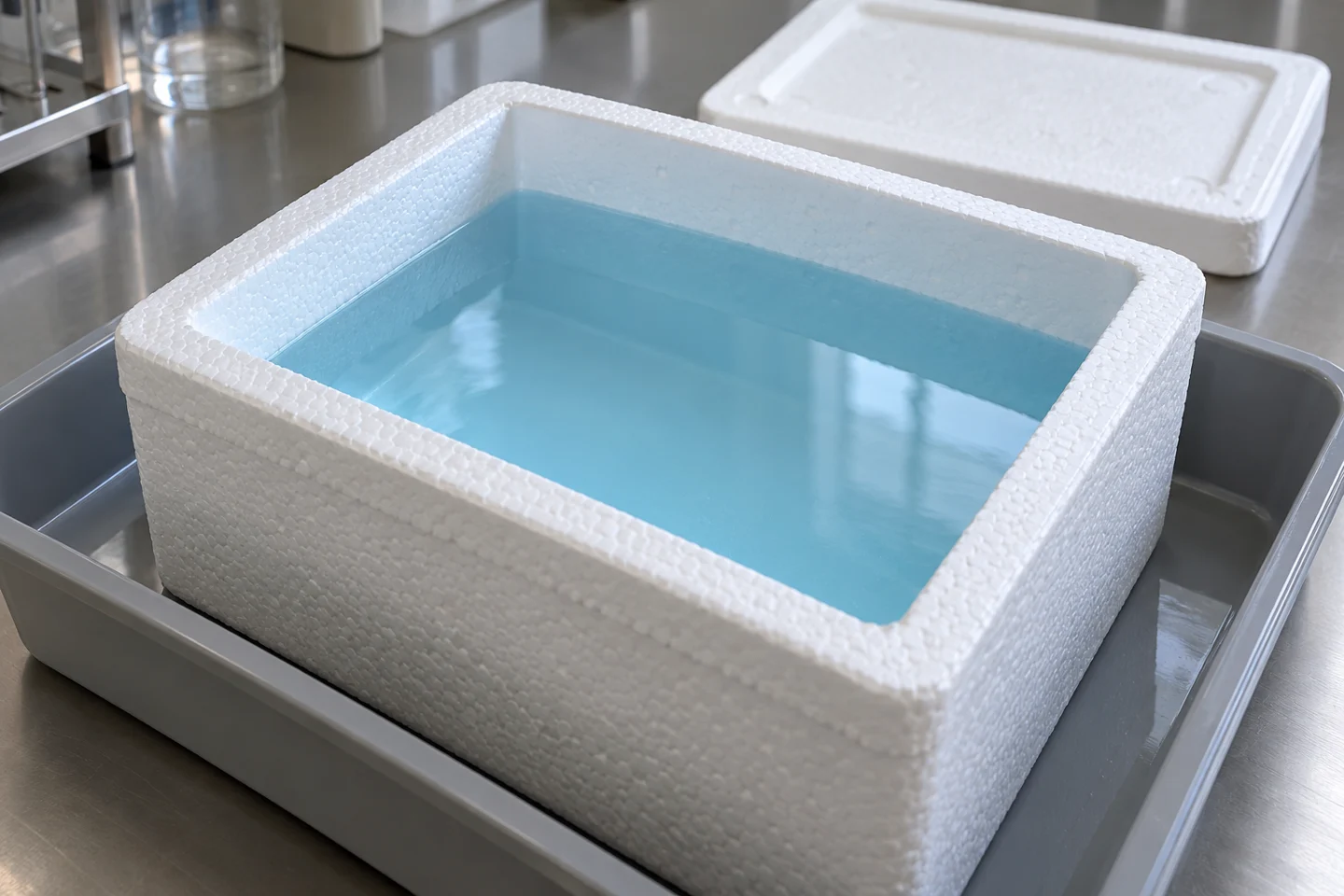
For an absorption report, ASTM’s method addresses direct liquid exposure:
The absorption test measures direct contact exposure to free water.
Immersion results cannot compare resistance to water-vapor transmission and subsequent cell condensation.
Different specimen and product surface-to-volume ratios can make test results misleading.
Keep the immersion specimen description with the report. Ask for the surface-to-volume basis when relating a specimen result to the molded shipper wall.
Distinguish water content from the thermal question
For its indicative water-content check, BASF describes weighing the molding around the drying process: The molding is weighed before and after drying.
In BASF’s Styropor thermal discussion:
Thermal conductivity increases with moisture content.
Keep drying-based water-content records, liquid-exposure records and thermal records in distinct sections of the acceptance file. For broader wall-material selection, use the cold shipping box wall-material comparison.
Build the incoming acceptance record
Begin with visible condition. For Styropor molded-part inspection: Molded parts are checked for damage to surfaces, corners and edges after manufacture or before use.
Use the following worksheet headings when preparing the lot review. Fill in the applicable method and agreed criterion before recording the decision.
| Record group | Fields to complete |
|---|---|
| Part identity | Lot, part or drawing revision, body or lid, sample location |
| Visible condition | Surface, corner and edge observations; photograph reference |
| Fusion assessment | Fracture photograph, estimation method, ruptured-particle percentage, acceptance criterion |
| Mass and density | Drying condition, component weighed, dry mass, sample volume and its source, density definition |
| Water assessment | Selected method, conditioning, exposure, observations and result |
| Disposition | Criterion source, decision, corrective action, inspector and inspection date |
Download the EPS shipper-wall acceptance worksheet. Attach the supporting photographs and reports, then record the lot decision against the agreed criteria. Continue to protective mailers and packaging to organize the wider packaging requirements.
Sources
- BASF — Styropor technical information compilation: molded-part inspection, preexpansion inspection, mechanical properties and water behavior.
- Lifoam Industries — patent description of foam-particle fusion.
- ISO — cellular plastics and rubbers density-method definition.
- ASTM International — Standard Test Method for Apparent Density of Rigid Cellular Plastics.
- ASTM International — Standard Test Method for Water Absorption of Rigid Cellular Plastics.