Specifying insulated bubble mailers by external pouch dimensions and a generic “silver thermal bubble” description causes side-seam blowouts during air-cargo decompression, bottom-gusset channel leaks, and rejected or melted confections when tight-stuffed payloads collapse the internal radiant air gap. Engineering a reliable metallized foil bubble mailer for 12 to 36 hour overnight and regional last-mile fulfillment requires pairing the multi-layer laminate stack (12 µm VMPET, coextruded polyamide-barrier cellular bubble core, and 35–50 µm LLDPE inner sealant) with calibrated ASTM F88 / ASTM F1140 perimeter weld parameters and dew-point-buffered phase-change coolants.
Within our protective mailers and boxes series, our industrial bag sealing equipment guide establishes the foundational rule to verify the actual joining polymer faces before running a sealer trial, while our insulated shipping boxes liner dimension worksheet defines interior cavity deductions for rigid cartons. This companion specification supplies the quantitative polymer-converting, seal-testing, and short-duration packout math for flexible mailers: contrasting vacuum-metallized polyester (VMPET) and foil bubble laminates against curbside-recyclable paper pouches, deriving the 145–175 °C heat-seal window across 2-ply side welds and 4-ply bottom-gusset transitions, and configuring thermal bubble mailers for chocolate so cocoa butter stays within its +14 °C to +26 °C (57 °F to 79 °F) Polymorph V window.
Specify the multi-layer laminate structure of a metallized foil bubble mailer
When selecting insulated bubble mailers across temperature-controlled packaging constructions or preparing rollstock on a slitting and rewinding machine, packaging engineers evaluate a 4-to-7-layer coextruded and laminated composite web in which each polymer or metallic ply performs a distinct radiative, gas-barrier, mechanical-cushioning, or heat-sealing function.
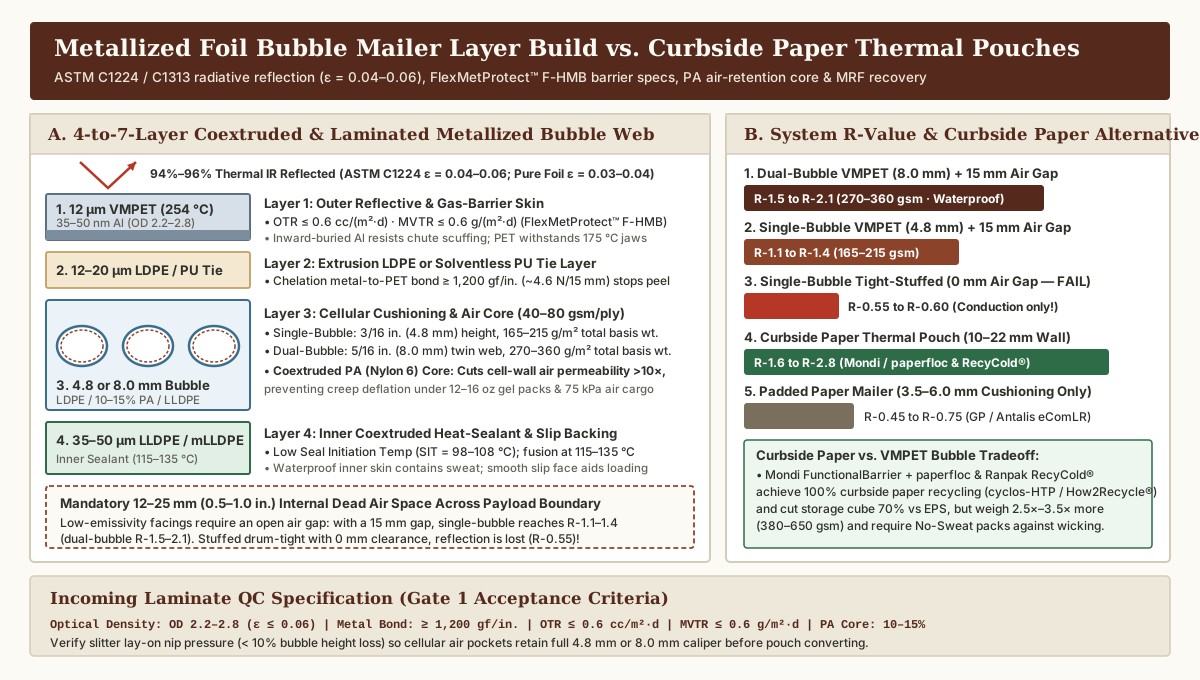
1. Layer-by-layer polymer and metallic barrier architecture
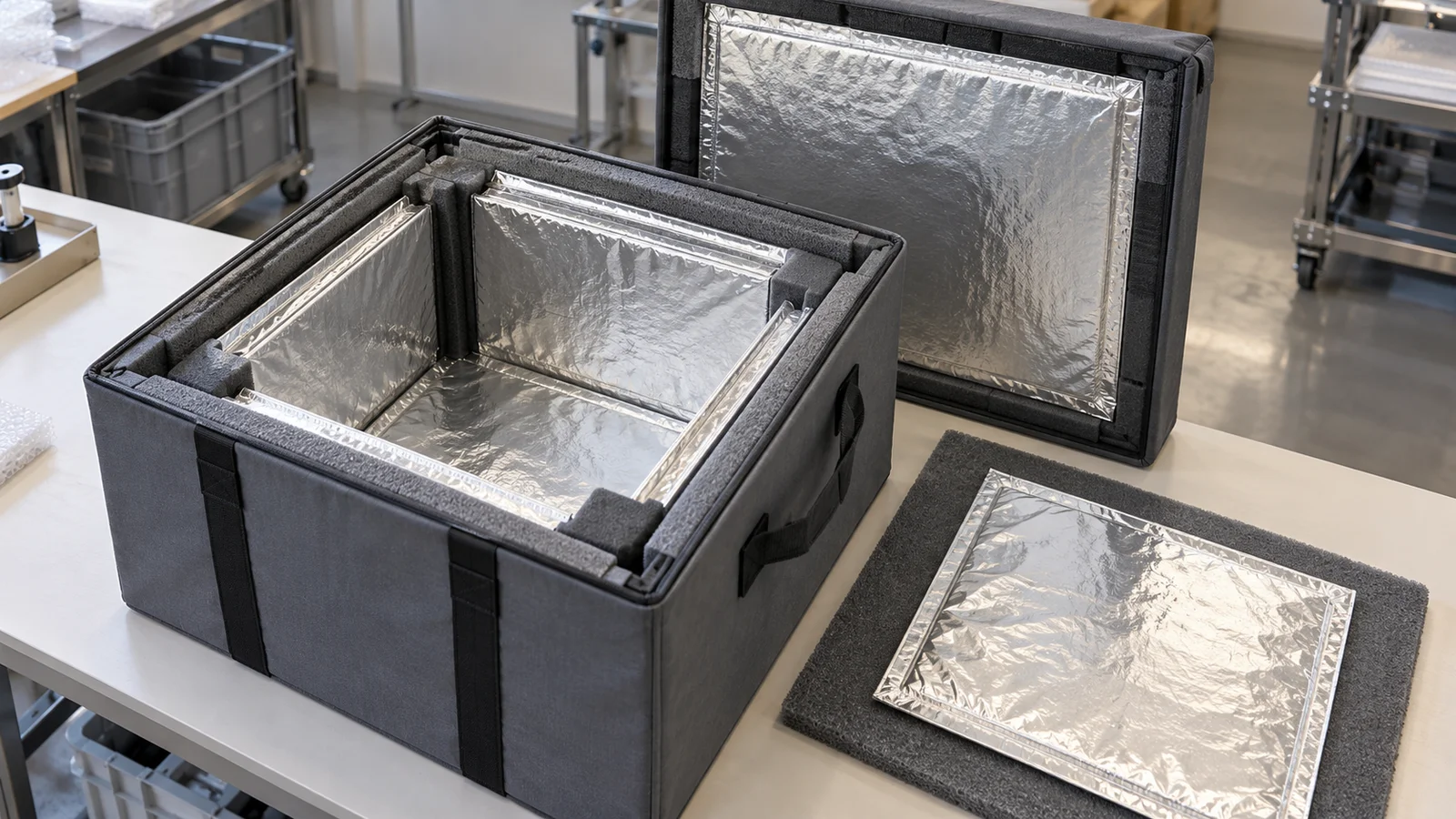
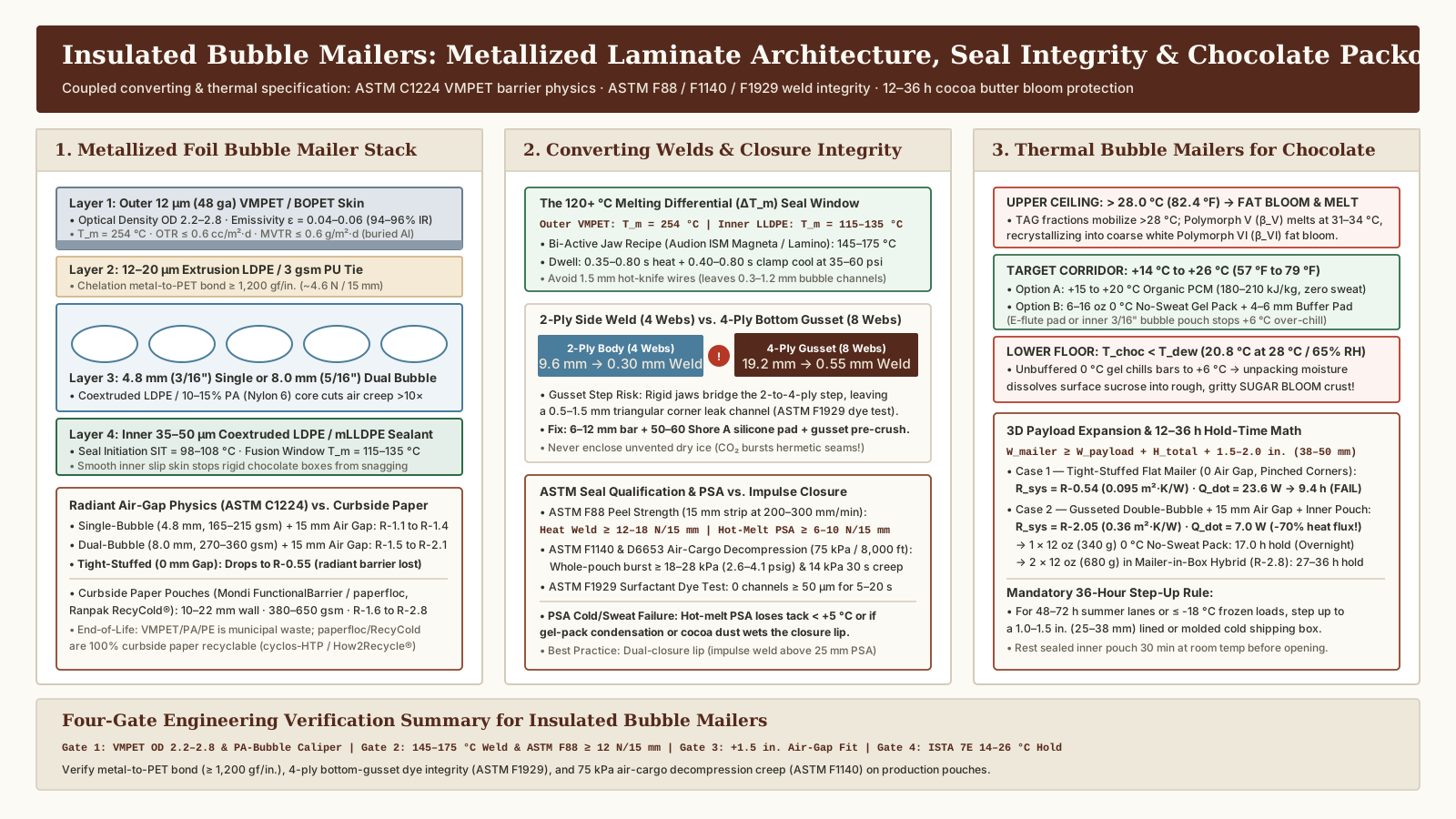
As documented in Metal Architecture and Fi-Foil’s ASTM C1224 / C1313 reflective bubble insulation analysis and Flex Films’ FlexMetProtect™ F-HMB high-barrier metallized polyester film specifications, a production-grade metallized foil bubble mailer comprises four functional zones from exterior to interior:
- Layer 1 — Outer Reflective & High-Barrier Skin (
12 µm VMPETvs.7–9 µm Pure Aluminum Foil):- Vacuum-Metallized Biaxially Oriented Polyester (
VMPET / MPET,12 µm/48 gaugeBOPET): The workhorse outer facing on e-commerce insulated bubble mailers. A12 µm(0.48 mil) biaxially oriented polyethylene terephthalate (BOPET) carrier film is vacuum-metallized with a35 to 50 nm(350 to 500 Å) vapor-deposited layer of99.5%pure aluminum to an optical density (OD) of2.2 to 2.8.- Radiative Emissivity (
ε) and Infrared Reflectivity: Achieves a thermal surface emittance ofε = 0.04 to 0.06(94% to 96%thermal infrared reflectivity), well below theASTM C1224(Standard Specification for Reflective Insulation) andASTM C1313(Standard Specification for Sheet Radiant Barriers) ceiling ofε ≤ 0.10(≥ 90%reflectivity) (see also Metal Architecture’s radiant barrier guide). - Oxygen, Moisture Vapor, and Odor Barrier: In untreated metallized PET films, poor adhesion between vapor-deposited aluminum and the base polyester leads to metal craze cracking and barrier loss over converting rollers. Chelation-treated composite
BOPET(such as Flex FilmsFlexMetProtect™ F-HMB) achieves a metal-to-PET bond strength of1,200 gf/in.(~4.6 N / 15 mm), an oxygen transmission rate ofOTR = 0.6 cc/(m²·day)at23 °C / 0% RH, and a moisture vapor transmission rate ofMVTR = 0.6 g/(m²·day)at38 °C / 90% RH—blocking humid summer air and corrugated parcel odors from permeating into thermal bubble mailers for chocolate. - High Crystalline Melting Point (
T_m ≈ 250–254 °C/482–489 °F): BecauseBOPETremains dimensionally stable up to254 °C, heated sealing bars (145–175 °C) can clamp directly against the outerVMPETskin to conduct heat inward without polymer sticking or jaw fouling.
- Radiative Emissivity (
- Pure Rolled Aluminum Foil Laminate (
7–9 µmAl Foil +12 µmPET Over-Lacquer): Specified for heavy clinical-trial and specialty pharma pouches. Pure7 to 9 µm(0.28 to 0.35 mil) rolled foil lowers surface emissivity toε = 0.03 to 0.04(96% to 97%IR reflectivity) and drivesOTRandMVTRbelow0.05, but pure aluminum foil exhibits lower flex-crack endurance thanVMPETunder repeated parcel chute folding.
- Vacuum-Metallized Biaxially Oriented Polyester (
- Layer 2 — Inward-Buried Aluminum Interface & Tie Layer (
12–20 µm Extrusion LDPEor2.5–3.5 gsm Solventless PU): Converters orient the12 µm VMPETfilm so the40 nmvapor-deposited aluminum layer faces inward against the lamination adhesive rather than outward to the open air. Burying the aluminum layer behind the tough12 µm BOPETskin protects the sub-micron metal deposit from conveyor scuffing, acid moisture oxidation, and PTFE seal-bar abrasion, while high chelation bond strength (≥ 1,200 gf/in.) prevents layer delamination when bubble cells expand during air transit. - Layer 3 — Cellular Bubble Cushioning Core (
3/16 in. / 4.8 mm Single-Bubblevs.5/16 in. / 8.0 mm Dual-BubblewithPA/NylonBarrier): Thermoformed on vacuum-drum cylinders in3/16 in.(4.8 mmheight,10 mmcell diameter) single-bubble (40 to 65 gsmcellular web, total laminate basis weight165 to 215 g/m²) or5/16 in.(8.0 mmheight) heavy/dual-bubble (270 to 360 g/m²total laminate).- Why a
10%–15%Coextruded Polyamide (PA / Nylon 6) Core Is Mandatory for Cold Mailers: Standard mono-layerLDPEpackaging bubbles gradually deflate under static payload compression (creep) because trapped air permeates through thin stretchedLDPEcell walls. Coextruding a3 to 6 µmpolyamide (PA / Nylon 6) gas-barrier core inside the bubble web (LDPE / Tie / PA / Tie / LLDPE) reduces cell-wall air permeability by> 10×, preventing bubble flattening under heavy12 to 16 ozgel packs and preserving the4.8 to 8.0 mmconductive air core across24 to 36 hours.
- Why a
- Layer 4 — Inner Coextruded Heat-Sealant & Slip Backing (
35–50 µm/1.4–2.0 milLDPE / LLDPE / mLLDPE): Laminated across the inner bubble crests to form a smooth inner slip surface (so rigid chocolate ballotin boxes slide in without snagging cellular domes). Formulated from low-density polyethylene (LDPE,T_m ≈ 110–115 °C) blended with linear low-density or metallocene polyethylene (LLDPE / mLLDPE,T_m ≈ 120–128 °C, seal initiation temperatureSIT = 98–108 °C) to deliver high hot-tack and waterproof containment of internal gel-pack sweat.
2. Comparing metallized bubble mailers against curbside-recyclable paper thermal pouches
While multi-layer VMPET / PA-LDPE / LLDPE bubble mailers maximize radiant reflection, moisture barrier, and featherweight parcel postage (28 to 42 g for a 10 × 13 in. pouch), their commingled plastic-and-metal construction cannot be repulped in paper mills or sorted into municipal film recycling streams. Packaging engineers weighing moisture durability against curbside recovery compare five commercial flexible mailer architectures documented by Mondi and easy2cool (FunctionalBarrier paper + paperfloc), Ranpak (RecyCold® climaliner™), Georgia-Pacific, and Antalis (Paragon eComLR / PapairWrap):
| Mailer Architecture & Commercial Examples | Total Wall Caliper & Basis Weight (g/m²) |
Surface Emissivity (ε) & Assembled R-Value (°F·ft²·h/BTU) |
Moisture Vapor Barrier & Condensate Behavior | Converting Seal Route & End-of-Life MRF Pathway |
|---|---|---|---|---|
1. Single-Bubble Metallized Foil Bubble Mailer (3/16 in. / 4.8 mm)12 µm VMPET (OD 2.4) + 15 µm LDPE tie + 4.8 mm PA/LDPE barrier bubble + 40 µm LLDPE inner sealant |
4.8 – 5.2 mm (0.19 in.)165 – 215 g/m²( ~28–42 g per 10 × 13 in. mailer) |
• Surface ε = 0.04–0.06 (94%–96% IR reflectivity, ASTM C1224)• With 12–25 mm air gap: R-1.1 to R-1.4• Tight-stuffed ( 0 gap): R-0.55 to R-0.60 |
Waterproof vapor & odor barrier (MVTR ≤ 0.6 g/m²·day, OTR ≤ 0.6 cc/m²·day); fully contains internal gel-pack sweat |
6–10 mm compression side weld (145–165 °C) + 20–25 mm hot-melt PSA strip; Not curbside recyclable (multi-material VMPET/PA/PE → municipal waste) |
2. Dual-Bubble / Heavy Metallized Foil Bubble Mailer (5/16 in. / 8.0 mm)12 µm VMPET or 7 µm Al Foil + twin cellular PA/LDPE bubble cores + 50 µm mLLDPE inner sealant |
8.0 – 9.5 mm (0.31 – 0.37 in.)270 – 360 g/m²( ~55–85 g per 12 × 15 in. gusseted mailer) |
• Surface ε = 0.03–0.05 (95%–97% IR reflectivity)• With 12–25 mm air gap: R-1.5 to R-2.1• Tight-stuffed ( 0 gap): R-0.95 to R-1.10 |
Hermetic moisture & radiant barrier; dual bubble plies resist corner pinch-through under sharp chocolate boxes and bottom gel packs | Bi-active impulse / constant-heat bar (155–175 °C, 0.50–0.80 s at 4-ply gusset); Not curbside recyclable (reusable as secondary cold pouch) |
3. Metallized Closed-Cell EPE Foam Mailer (3.0 – 6.0 mm)12 µm VMPET + 3–6 mm extruded closed-cell polyethylene foam (22–28 kg/m³) + 40 µm LLDPE inner film |
3.2 – 6.2 mm (0.13 – 0.24 in.)140 – 230 g/m² |
• Surface ε = 0.04–0.06• With 12–25 mm air gap: R-1.3 to R-1.8• Tight-stuffed ( 4 / 6 mm): R-0.58 / R-0.88 (k = 0.039 W/(m·K)) |
Micro-cellular closed-cell foam cannot pop under 75 kPa air-cargo decompression or point loads; waterproof inner/outer skins |
Wide-bar impulse or constant-heat weld (8–12 mm seam) + PSA lip; Not curbside recyclable (composite VMPET/EPE laminate) |
| 4. Curbside-Recyclable Waved-Kraft & Cellulose Thermal Pouches Mondi FunctionalBarrier + easy2cool paperfloc (shredded cellulose) or Ranpak RecyCold® multi-ply waved kraft pouch |
10.0 – 22.0 mm (0.40 – 0.87 in.)380 – 650 g/m²( 2.5×–3.5× heavier than bubble mailer) |
• Surface ε ≈ 0.88–0.92 (non-reflective kraft paper)• Conductive wall resistance ( 12–20 mm): R-1.6 to R-2.8 (k = 0.038–0.044 W/(m·K)) |
Relies on Mondi FunctionalBarrier paper coating or moisture-resistant kraft + No-Sweat / paper cool packs to prevent wet-strength loss |
Heat-sealable functional barrier coating or hot-melt PSA strip; 100% curbside paper recyclable (cyclos-HTP / How2Recycle®) |
5. Curbside-Recyclable Padded Paper Mailers (Light Cushioning)Georgia-Pacific expanded-cellulose kraft mailer or Antalis Paragon eComLR / PapairWrap bubble-paper mailer |
3.5 – 6.0 mm (0.14 – 0.24 in.)240 – 380 g/m² |
• Surface ε ≈ 0.90 (zero radiant reflection)• Conductive resistance ( 4–6 mm): R-0.45 to R-0.75 (mechanical cushioning only) |
Hygroscopic kraft paper absorbs ambient humidity and gel-pack sweat unless paired with a sealed inner barrier pouch | Cold-glue / hot-melt perimeter seam + peel-and-seal PSA strip; How2Recycle® single-stream curbside paper recyclable |
Selection Takeaway: Specify a dual-bubble (
8.0 mm) or single-bubble (4.8 mm)metallized foil bubble mailerwith12 µm VMPET (OD 2.2–2.8)and a10%–15% PAcoextruded bubble core whenever12–36 hshipments require a waterproof vapor barrier (MVTR ≤ 0.6 g/m²·day), radiant solar reflection (ε = 0.04–0.06across a12–25 mmair space), and minimal tare weight. When brand sustainability mandates single-stream curbside paper recycling (How2Recycle®orcyclos-HTP), specify10–22 mmwaved-kraft or shredded-cellulose barrier pouches (MondiFunctionalBarrier/ easy2coolpaperflocor RanpakRecyCold®) paired with non-sweating cool packs.
Engineer side-weld converting and heat-seal vs. PSA closure integrity
Building on our industrial bag sealer compatibility guide and insulated liner converting traveler, converting a multi-layer metallized foil bubble mailer roll into a leak-free pouch—and closing its mouth reliably at the fulfillment bench—requires managing the polymer melting-point differential (ΔT_m > 120 °C) and cellular air-pocket collapse across 2-ply and 4-ply transitions.
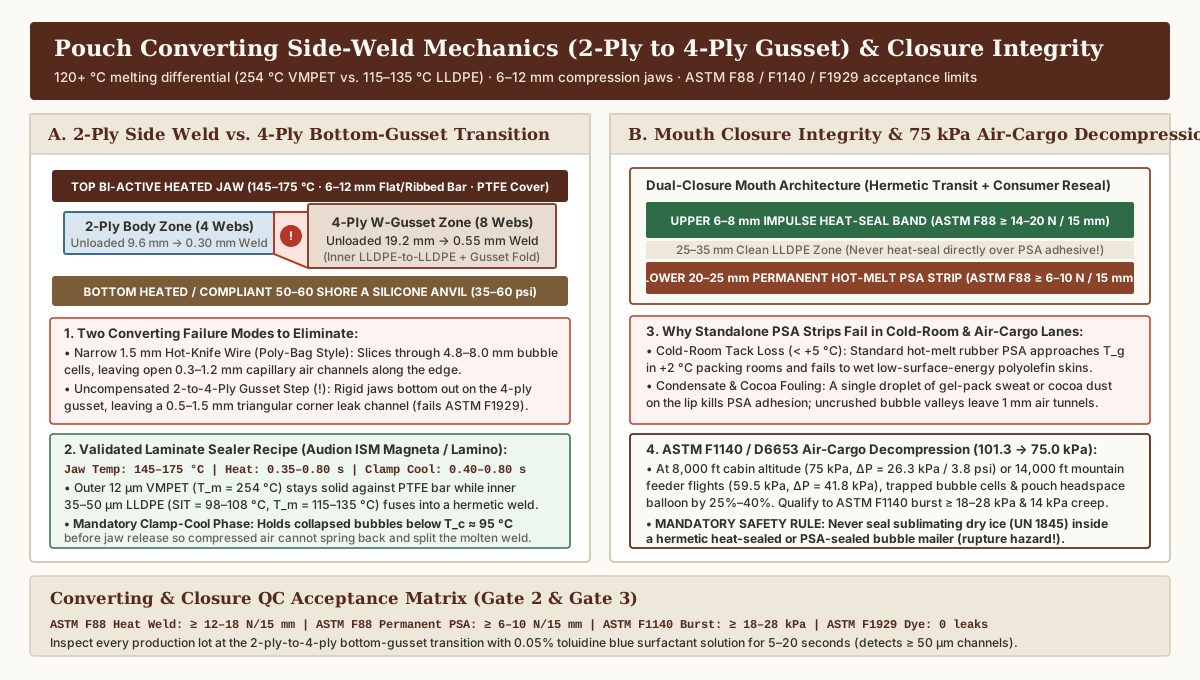
1. The 120+ °C melting differential (254 °C outer VMPET vs. 115–135 °C inner LLDPE)
As documented in Audion Elektro’s Lamino constant-heat laminate sealer specifications, attempting to weld a bare polyethylene bubble film on uncovered constant-heat jaws causes the exposed outer LDPE (T_m ≈ 110–115 °C) to melt directly onto the metal bars. A laminated metallized foil bubble mailer creates a wide, repeatable thermal processing window through asymmetric polymer layering:
- Outer Jaw-Contact Layer (
12 µm VMPET / BOPET): Crystalline melting pointT_m,PET = 250 °C to 254 °C(482 °F to 489 °F), with the40 nmaluminum layer buried on the inner lamination interface (which accelerates transient thermal conduction into the web while preventing aluminum rub-off on the PTFE glass jaw cover). - Middle Cellular Bubble Core (
LDPE / PA / LLDPE): Softens and collapses under jaw clamping pressure between108 °C and 125 °C(while the thin Nylon 6 barrier core at T_m ≈ 220 °C presses flat inside the weld matrix). - Inner Sealant Interface (
35–50 µm Coextruded LDPE / LLDPE / mLLDPE): Seal Initiation Temperature (SIT) of98 °C to 108 °Cand full entanglement fusion plateau of115 °C to 135 °C(239 °F to 275 °F). - Bi-Active Jaw Operating Window (
145 °C to 175 °C/293 °F to 347 °F): On industrial bi-active impulse sealers (equipped with top and bottom heated 5 to 8 mm nichrome seal bars and electromagnetic clamping, such as thePAC Machinery / AudionISMIndustrial Sealer Magneta) or PTFE-covered constant-heat laminate bars (Audion Lamino), setting jaw temperature between145 °C and 175 °Cmaintains a75 °C to 105 °Csafety margin below the254 °Cmelting point of outerVMPET. Across0.35 to 0.80 secondsof heat dwell, conductive heat collapses the cellular core and raises the two facing innerLLDPEsealant skins to125–135 °Cso polymer chains interdiffuse into a monolithic weld.
2. Side-weld (2-ply / 4-web) vs. bottom-gusset (4-ply / 8-web) converting mechanics
Horizontal pouch-making lines convert insulated bubble mailers in two primary geometries (paralleling the pouch fold mechanics in our 1-piece gusseted vs. 2-piece die-cut box liner comparison):
- Flat 2-Side-Seal (
3-Side-Seal) Pillow Mailers (2-Ply Stack = 4 Film/Bubble Webs) & Why Hot-Knife Wires Fail: A single mother web (slit to tolerance per ourslitting and rewinding guide) is center-folded (V-foldedwith an extended40 to 65 mmtop closure lip) so the bottom fold is continuous seamless material and only the two vertical side seams require welding.- The
1.5 mmHot-Knife Failure Mode: If a converter attempts to cut and seal a4.8 to 8.0 mmbubble laminate using a narrow1.5 to 2.0 mmhot-knife wire (designed for flat 2.5 mil poly mailers), trapped air inside cut bubble domes expands and blows open0.3 to 1.2 mmcapillary micro-channels along the cut edge. High-integrity bubble mailers require a6 to 12 mm(0.25 to 0.47 in.) flat or serrated compression weld bar that squeezes air out of the weld zone before a separate cold flying knife or rotary shear trims the web outside the seal.
- The
- Bottom-Gusseted (
W-Fold) Box-Bottom Mailers (2-Ply to 4-Ply Transition = 8 Webs): To hold three-dimensional chocolate gift boxes or diagnostic kits flat on their base (likeIPCCooLiner™gusseted pouches), a W-plow forms an inward bottom gusset of depthG = 50 to 100 mm(2 to 4 in.). Along the lowerG / 2(25 to 50 mm) of both vertical side seams, the sealing bars must simultaneously weld four full plies of metallized bubble laminate (8 polymer/metallic sub-stacks, compressing19.2 mmof unloaded single-bubble caliper down to a solid0.50 to 0.65 mmfused seam) right beside the upper 2-ply (9.6 mmunloaded) body section.- Eliminating the Gusset Step Channel Leak: Rigid metal-to-metal jaws bottom out on the thick
4-plygusset section, creating a0.5 to 1.5 mmpressure drop at the exact transition step where the inner gusset fold ends—leaving a triangular gusset corner leak channel. Converters eliminate this defect by pairing bi-active top and bottom heating (160–175 °Cat the gusset zone, or an upstream ultrasonic/heated gusset pre-crush station) with a50 to 60 Shore Acompliant silicone-rubber backup pad at35 to 60 psi(0.24 to 0.41 MPa) clamping pressure, followed by a mandatory0.40 to 0.80 scooling-under-pressure hold phase so compressed bubble walls cannot spring back and split the moltenLLDPEweld before it crystallizes belowT_c ≈ 95 °C.
- Eliminating the Gusset Step Channel Leak: Rigid metal-to-metal jaws bottom out on the thick
3. Quantitative seal qualification (ASTM F88, ASTM F1140, ASTM F1929) and air-cargo decompression
Packaging engineers qualify converted side welds and fulfillment mouth closures against four laboratory test standards:
1. ASTM F88 Seal Peel Strength (15 mm strip at 200–300 mm/min, Technique A/B):
   • Permanent Hot-Melt PSA Closure (after 20 min dwell):  F_peel ≥ 6.0 – 10.0 N / 15 mm (2.3 – 3.8 lbf/in.)
   • Converted Side Weld & Impulse Top Heat Seal:          F_peel ≥ 12.0 – 18.0 N / 15 mm (4.6 – 6.9 lbf/in.)

2. ASTM F1140 / ASTM D6653 Air-Cargo Decompression Differential (ΔP_cargo):
   • Sea Level (101.3 kPa) → 8,000 ft Cabin Altitude (75.0 kPa):       ΔP = 26.3 kPa (3.81 psi)
   • Sea Level (101.3 kPa) → 14,000 ft Mountain Feeder (59.5 kPa):     ΔP = 41.8 kPa (6.06 psi)
• Whole-Mailer ASTM F1140 Acceptance: Burst ≥ 18 – 28 kPa (2.6 – 4.1 psig); 30 s Creep Hold at 14 kPa- Why
75 kPaAir-Cargo Decompression Ruptures Weak Welds (ASTM F1140/ASTM D6653): When insulated bubble mailers travel via overnight air express (FedEx Priority OvernightorUPS Next Day Air) or high-elevation mountain ground passes, ambient pressure drops from101.3 kPa(14.7 psia) to75.0 kPa(10.9 psiaat8,000 ft) or59.5 kPa(8.6 psiaat14,000 ft). Every sealed air cell in the bubble web expands by25% to 40%, while any trapped room-pressure air inside the hermetic pouch inflates the mailer like a pillow—applying sustained peel-and-creep tension across the perimeter weld and top closure. If a converter overheated the side weld and thinned (neck-down) the innerLLDPEfilm along the seal edge, expanding peripheral bubbles shear open the heat-affected zone (HAZ). - Mandatory Prohibition on Unvented Dry Ice (
UN 1845): Because heat-sealed and permanent-PSA metallized foil bubble mailers form gas-tight enclosures (holding 18 to 28 kPa before bursting violently under ASTM F1140), never seal sublimating dry ice (solid CO₂ at -78.5 °C, which expands~845×in volume from solid to gas) inside an unvented bubble mailer. As detailed in our shipping frozen food with dry ice venting and IATA PI 954 guide, dry ice requires a vented rigid carton and liner assembly; sealed bubble mailers must only be paired with closed-pouch gel or Phase Change Material (PCM) packs. ASTM F1929Dye-Penetration Channel Detection (50 µmSensitivity): Injecting an aqueous surfactant solution containing0.05%toluidine blue dye (surface tension ~32 dynes/cm) inside the sealed mailer for5 to 20 secondsreveals micro-leaks as small as50 µmat the 2-ply-to-4-ply bottom-gusset transition and along hand-pressedPSAflaps where uncrushed bubble valleys create open capillary tunnels.
4. Fulfillment mouth closure comparison: PSA peel-and-seal vs. secondary impulse heat sealing
As established by the Adhesive and Sealant Council’s (ASC) PSA tape selection guidelines and Packaging Strategies’ cold-seal vs. heat-seal confectionery analysis, pressure-sensitive adhesive (PSA) closures bond by viscoelastic flow and surface wetting (requiring substrate surface energy above the adhesive's wetting threshold, sufficient coat weight to bridge rough cellular contours, and a dry, warm application interface). Comparing the four commercial mailer closure methods highlights why high-value perishable lines pair PSA strips with secondary impulse sealing:
| Closure Method & Equipment Specification | Interfacial Bonding Mechanism & Line Speed | ASTM F88 Peel Strength & ASTM F1140 Altitude Creep |
Fulfillment Failure Modes & Engineering Countermeasure |
|---|---|---|---|
1. Permanent Hot-Melt PSA Peel-and-Seal Strip20–25 mm (0.8–1.0 in.) synthetic rubber/resin transfer tape + siliconized release liner |
Pressure-activated viscoelastic wetting at +10 °C to +35 °C; requires 15–25 psi firm roller/hand swipe (0 s warmup, up to 10× faster bench closure than manual heat sealing) |
• ASTM F88 Peel: 6.0 – 10.5 N / 15 mm (tamper-evident inner LDPE tear at +23 °C)• ASTM F1140 Creep: Holds 8–14 kPa, but uncrushed bubble valleys leave 0.5–1.5 mm air channels if flap is not rolled flat |
• Cold-Room & Sweat Fouling (< +5 °C): Hot-melt rubber stiffens near its glass transition (T_g) in +2 °C cold rooms and completely fails to wet if gel-pack condensation droplets or cocoa dust land on the lip.• Countermeasure: Specify freezer-grade hybrid PSA and wipe lip dry before folding. |
2. Resealable Low-Tack Acrylic PSA Strip (Multi-Use)12–18 mm acrylic transfer tape on fold-over flap |
Clean peel-and-reseal adhesive (allows inspection or consumer reuse); lower initial tack on low-surface-energy polyolefin skins |
• ASTM F88 Peel: 2.0 – 4.5 N / 15 mm• ASTM F1140 Creep: Prone to slow peel-open (flagging) under rigid carton edge tension or air-cargo decompression |
• Elastic Spring-Back Pop-Open: Stiff 8.0 mm dual-bubble flaps folded 180° exert bending torque that peels low-tack strips open within 2–6 h.• Countermeasure: Restrict to inner sub-pouches inside a closed box; never use as standalone outer parcel closure. |
3. Bi-Active Impulse Heat Seal (Dual-Closure Lip)5–8 mm (3/16–5/16 in.) dual-heated nichrome bars (PAC Machinery / Audion ISM Magneta) |
Polymer chain fusion of inner 35–50 µm LLDPE layers (145–165 °C jaw temp); 0.40–0.70 s heat dwell + 0.50–0.80 s electromagnetic clamp cool (35–55 psi) |
• ASTM F88 Peel: 14.0 – 20.0 N / 15 mm (true hermetic fusion weld)• ASTM F1140 Burst: 18 – 28 kPa; 0 dye leaks (ASTM F1929) when bubble domes are crushed flat under 5–8 mm bar |
• Sealing Over the PSA Tape Strip: Clamping heated jaws directly over PSA adhesive melts glue squeeze-out and creates channel voids.• Countermeasure: Specify a 25–35 mm clean LLDPE seal band above the 20–25 mm PSA strip (impulse weld for transit, PSA strip for consumer reseal). |
| 4. Constant-Heat Bar or Continuous Band Sealer PTFE-coated constant-heat jaws (Audion Lamino) or rotary band sealer (6–12 m/min) with cooling nip |
Continuous conduction through 12 µm VMPET outer skin (160–180 °C) followed by chilled compression rollers (requires VMPET/Foil/Paper outer layer—never bare outer PE!) |
• ASTM F88 Peel: 15.0 – 22.0 N / 15 mm (8–12 mm wide ribbed/knurled weld)• ASTM F1140 Burst: 20 – 30 kPa (highest seam uniformity across 2-to-4-ply gussets) |
• Payload Hanging Stress & Chocolate Proximity: Heavy pouches (> 1.5 kg) pulling on a hot weld delaminate the seam (see bag sealer trial guide).• Countermeasure: Support pouch bottom on a synchronized conveyor and keep chocolate ≥ 50 mm below heated bars. |
Selection Takeaway: Require
6–12 mmcompression side welds (never 1.5 mm hot-knife wires) qualified toASTM F88 ≥ 12–18 N / 15 mm,ASTM F1140 ≥ 18 kPaburst, and0ASTM F1929dye channels across the 2-ply-to-4-ply bottom-gusset step. For summer air express or cold-room fulfillment where gel-pack sweat foulsPSAstrips, specify a dual-closure mouth with a25–35 mmcleanLLDPEband above thePSAtape for a5–8 mmbi-active impulse weld (145–165 °C,0.40–0.70 sheat +0.50–0.80 sclamp cool).
Configure thermal bubble mailers for chocolate, confections, and 12–36 hour last-mile packs
The largest seasonal volume for insulated bubble mailers is thermal bubble mailers for chocolate, artisan pralines, pectin/gelatin gummies, heat-sensitive cosmetics, and ambient/chilled biologics shipped across 12 to 36 hour (overnight air or 1-day regional ground) parcel lanes.
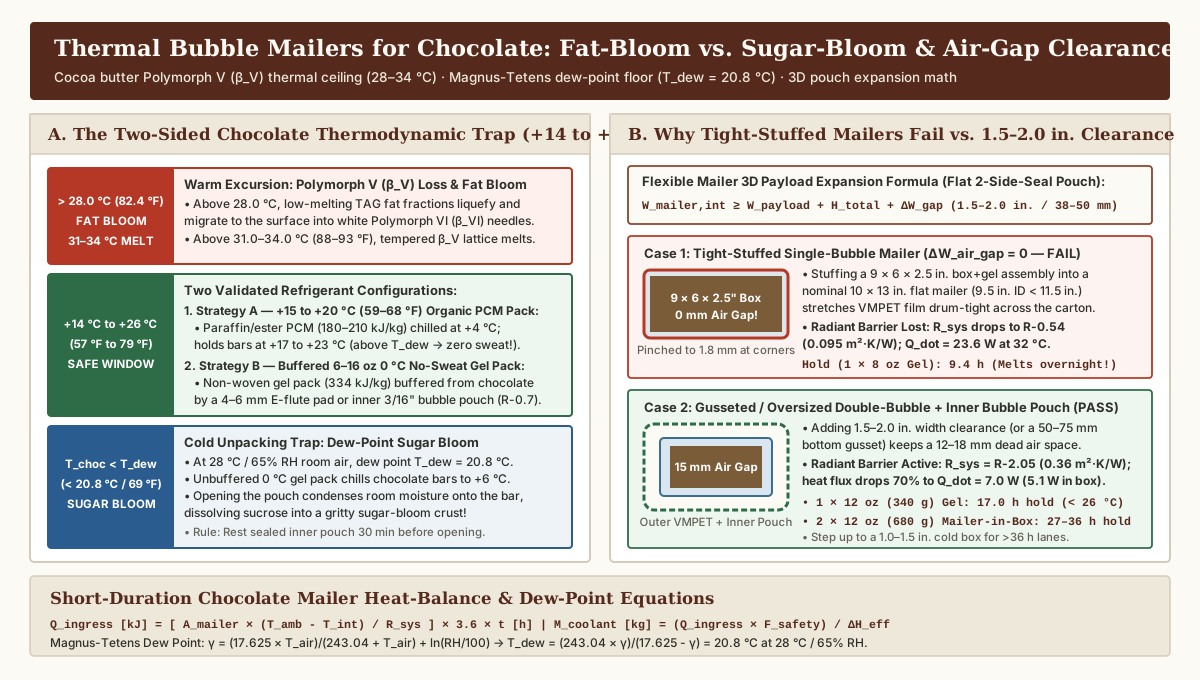
1. The two-sided chocolate thermodynamic corridor: fat bloom (> 28 °C) vs. dew-point sugar bloom (< T_dew)
As documented by confectionery packaging machinery manufacturers PFM Group and Wolf Packing alongside psychrometric dew-point physics from Compressed Air Best Practices, shipping chocolate in a flexible mailer is constrained by a narrow +14 °C to +26 °C (57 °F to 79 °F) safe corridor bounded by two irreversible crystal defects:
- Upper Thermal Ceiling — Cocoa Butter Polymorph V (
β_V) Melting & Fat Bloom (> 28.0 °C/82.4 °F): Tempered dark, milk, and white chocolates owe their glossy mirror surface, mold contraction, and crisp snap to cocoa butter crystallized in Polymorph V (β_V, one of six polymorphic crystal forms, I through VI):- Complete Polymorph V Melting (
31.0 °C to 34.0 °C/87.8 °F to 93.2 °F): Above31–34 °C, theβ_Vcrystal lattice melts completely into liquid fat, deforming molded bars, hollow figures, and enrobed truffles. - Sub-Melting Fat-Bloom Onset (
28.0 °C to 30.5 °C/82.4 °F to 86.9 °F): Even if a mailer interior never reaches32 °C, holding tempered chocolate above28.0 °C(82.4 °F) for more than2 to 4 hoursliquefies low-melting triacylglycerol (TAG) fractions inside the cocoa butter matrix. When the package cools after delivery, those mobilized liquid fats migrate by capillary action to the surface and recrystallize into coarse, light-scattering Polymorph VI (β_VI) needles—producing dull, grayish-white fat bloom.
- Complete Polymorph V Melting (
- Lower Psychrometric Floor — Why Unbuffered
0 °CGel Packs Trigger Unpacking Sugar Bloom (T_choc < T_dew): When fulfillment operators pack thermal bubble mailers for chocolate by placing a standard0 °C(+32 °F) water-hydrogel pack (pulled from a -20 °C freezer or +2 °C walk-in cooler) directly against a thin chocolate carton, they induce sugar bloom upon customer unpacking:- The Unpacking Dew-Point Calculation (
Magnus-TetensEquation): Suppose an unbuffered0 °Cgel pack chills an internal chocolate bar toT_choc = +6.0 °C(42.8 °F) inside a sealed metallized foil bubble mailer. When the customer opens the pouch in a summer kitchen or porch atT_air = 28.0 °C(82.4 °F) andRH = 65%, the ambient psychrometric dew point (T_dew, see our gel packs for shipping food sweat-control guide) is:
- The Unpacking Dew-Point Calculation (
γ(T_air, RH) = (17.625 × 28.0) / (243.04 + 28.0) + ln(0.65) = 1.8206 - 0.4308 = 1.3898

T_dew [°C] = (243.04 × 1.3898) / (17.625 - 1.3898) = 20.8 °C (69.4 °F)- Immediate Condensation & Sucrose Recrystallization: Because the chocolate surface (
+6.0 °C) sits14.8 K(26.6 °F) below the room’s20.8 °Cdew point, water vapor in the room air condenses instantly into a microscopic liquid film across the chocolate surface. That condensed water dissolves fine sucrose crystals on the chocolate exterior; as the moisture later evaporates, sucrose recrystallizes into a rough, gritty, irreversible crust known as sugar bloom.
2. Refrigerant selection: +15 °C / +20 °C organic PCMs vs. buffered 6–16 oz 0 °C No-Sweat gel packs
Packaging engineers maintain the +14 °C to +26 °C chocolate corridor inside insulated bubble mailers using two refrigerant strategies grounded in Sonoco ThermoSafe’s small-format PolarPack® specifications (PP3 3 oz / 85 g, PP6 6 oz / 170 g, PP12 12 oz / 340 g, 16 oz / 454 g), Nordic Cold Chain Solutions’ small-format packout lab (Nordic Ice® No Sweat), and the International Institute of Refrigeration’s (IIR / IIFIIR) Phase Change Materials synthesis:
- Strategy A — Mid-Temperature
+15 °C(59 °F) to+20 °C(68 °F) Organic PCM Packs (Zero Sugar-Bloom Risk): Formulated from food-grade plant-derived fatty acids, esters, or linear paraffins (C16–C18 alkanes) with an isothermal melting plateau at+15 °C(59 °F),+18 °C(64.4 °F), or+20 °C(68 °F) and latent heat of fusionΔH_PCM = 180 to 210 kJ/kg(77 to 90 BTU/lb). Conditioned in a standard+2 °C to +5 °Crefrigerator (never a -20 °C freezer), a+18 °CPCM brick holds the mailer interior at+17 °C to +23 °C—well below the28 °Cfat-bloom ceiling and near or above the20.8 °Cindoor dew point, eliminating unpacking condensation. - Strategy B — Small-Format (
6–16 oz/170–454 g)0 °CNo-Sweat Non-Woven Gel Packs + Mandatory Thermal Buffer (D2C Workhorse): Because0 °Cpolymer hydrogel packs cost60% to 75%less than organic PCMs and deliver65%higher latent heat (ΔH_fusion = 334 kJ/kg, plus sensible warming to+15 °CyieldingΔH_eff ≈ 350 kJ/kg), high-volume D2C confectioners pair them with three mandatory controls:- Spunbond Non-Woven Moisture-Guard Exterior (
20–35 gsm SBPPlaminated over4.1 milPE): Wicks and locks150 to 250 g/m²of surface condensate so liquid droplets never pool inside the mailer (seenon-woven vs. poly gel pack comparison). - Mandatory
4–6 mmCorrugated or Inner Bubble Thermal Buffer (R-0.6 to R-0.9Contact Resistor): Place the chocolate gift box inside a sealed inner3/16 in.(4.8 mm) bubble sub-pouch—or separate the0 °Cgel pack from the chocolate carton with a4 mmsingle-wall corrugated pad (B-fluteorE-flute). This contact thermal resistance prevents localized+6 °Cover-chilling, holding the chocolate core at+12 °C to +18 °Cwhile the0 °Cgel pack intercepts ambient heat entering through the outer mailer wall. - 30-Minute Sealed Unpacking Equilibration: Print on the inner barrier sub-pouch: “Leave sealed inner pouch closed at room temperature for 30 minutes before opening so any moisture condenses on the outer film, not on the chocolate.”
- Spunbond Non-Woven Moisture-Guard Exterior (
3. 3D payload clearance math (1.5–2.0 in.) and 12–36 h heat-balance sizing
Extending our insulated shipping boxes cavity deduction worksheet and gusseted box-liner radiative air-gap physics to flexible insulated bubble mailers reveals why stuffing a rigid box into a nominally matching flat mailer destroys thermal hold time.
When a flat 2-side-seal pillow mailer of inside lay-flat width W_mailer,int and inside length L_mailer,int expands around a three-dimensional payload + coolant assembly of width W_p, length L_p, and combined thickness H_total = H_payload + H_gel + H_buffer, the flat pouch walls must wrap half of the vertical thickness on each side plus an intentional air-gap allowance ΔW_air_gap:
W_mailer,int ≥ W_p + H_total + ΔW_air_gap      (where ΔW_air_gap = 1.5 to 2.0 in. / 38 to 50 mm)

L_mailer,int ≥ L_p + H_total + L_seal_clearance (where L_seal_clearance = 2.0 to 3.0 in. / 50 to 75 mm)
For a sealed mailer of exterior surface area A_mailer (m²), effective system thermal resistance R_sys (m²·K/W), ambient exposure temperature T_amb (°C), internal target mean temperature T_int (°C), and transit duration t (hours), cumulative heat ingress Q_ingress (kJ) and required refrigerant mass M_coolant (kg) follow:
Q_dot [W]      = [ A_mailer × (T_amb - T_int) ] / R_sys

Q_ingress [kJ] = Q_dot [W] × t [h] × 3.6

M_coolant [kg] = (Q_ingress [kJ] × F_safety) / ΔH_eff [kJ/kg]
Compare two packouts for a 9.0 × 6.0 × 2.5 in. (229 × 152 × 64 mm) chocolate + gel assembly under a T_amb = 32.0 °C (89.6 °F) summer profile with target internal cavity mean T_int = 18.0 °C (64.4 °F, ΔT = 14.0 K):
- Case 1 — Tight-Stuffed Single-Bubble Flat Mailer (
Zero Air Gap,ΔW_air_gap = 0— FAIL): An operator forces the9.0 × 6.0 × 2.5 in.assembly (requiring W_p + H_total = 6.0 + 2.5 = 8.5 in.minimum perimeter width and9.0 + 2.5 = 11.5 in.length) into a snug9.5 × 12.0 in.flat mailer. The outerVMPETskin stretches drum-tight against the carton faces, collapsing the internal dead air space to0 mmand pinching the4.8 mmbubbles down to1.8 mmat the corners. Without an open air space, radiant reflection is bypassed (ASTM C1224); effective thermal resistance plummets fromR-1.35down toR-0.54(R_sys = 0.095 m²·K/W) acrossA_mailer = 0.16 m²:- Heat ingress rate at
32.0 °Cpeak ambient:Q_dot = (0.16 m² × 14.0 K) ÷ 0.095 m²·K/W = 23.58 W(84.9 kJ/hpeak thermal flux). - Even when combining initial ramp-up and payload sensible thermal mass with a single
8 oz(0.227 kg)0 °CNo-Sweat gel pack (ΔH_eff ≈ 350 kJ/kg,79.5 kJrefrigerant enthalpy), the chocolate core crosses the28.0 °Cfat-bloom threshold withint_hold = 9.4 hourstotal transit (melting before overnight morning delivery).
- Heat ingress rate at
- Case 2 — Properly Sized Double-Bubble Gusseted Mailer with
15 mmAir Gap + Inner Bubble Pouch (PASS): Specifying a10.5 × 14.5 in.bottom-gusseted (65 mmgusset) double-bubble metallized foil bubble mailer (providing +2.0 in. / 50 mm of width clearance) plus a sealed inner3/16 in.bubble sub-pouch around the chocolate box preserves a12 to 18 mmenclosed dead air space and raises system resistance by3.8×toR-2.05(R_sys = 0.36 m²·K/W) acrossA_mailer = 0.18 m²:- Heat ingress rate drops by
70.3%toQ_dot = (0.18 m² × 14.0 K) ÷ 0.36 m²·K/W = 7.00 W(25.2 kJ/h). - With
1 × 12 oz(0.340 kg)0 °CNo-Sweat gel pack (119 kJcapacity + chocolate sensible thermal mass): Maintains internal chocolate temperature< 26 °Cfor17.0 hours(covering 12–18 h overnight regional delivery). - With
2 × 12 oz(24 oz / 0.680 kgtotal)0 °CNo-Sweat gel packs (or 2 × 16 oz / 0.907 kg +18 °C organic PCM packs) nested inside a snug outer corrugated literature mailer box (Mailer-in-Box hybrid,R-2.8/R_sys = 0.49 m²·K/W,Q_dot = 5.14 W): Holds chocolate between+14 °C and +26 °Cfor27 to 36 hours.
- Heat ingress rate drops by
| Ambient Parcel Lane & Transit Window | Recommended Mailer & Air-Gap Buffer Architecture | Phase-Change Refrigerant Specification | Target Chocolate Temperature & Step-Up Boundary |
|---|---|---|---|
1. Mild Spring / Autumn Last-Mile (12 – 24 h)Ambient 20–26 °C (68–79 °F); brief doorstep solar exposure |
Single-Bubble Metallized Foil Bubble Mailer (4.8 mm wall) oversized by +1.5 in. (38 mm) width clearance (air gap preserved, R-1.3) + rigid retail ballotin box |
1 × 6 oz (170 g) +18 °C Organic PCM Pack or 1 × 6 oz (170 g) 0 °C No-Sweat Non-Woven Gel Pack (PolarPack® PP6 / Nordic Ice® No Sweat) + 4 mm E-flute divider |
Holds +16 °C to +24 °C (61–75 °F); outer VMPET reflects 94%–96% of porch solar radiation with zero unpacking sugar bloom |
2. Summer Regional Ground / Overnight Air (18 – 24 h)Ambient 28–33 °C (82–91 °F); ISTA 7E summer 24 h profile |
Dual-Bubble (8.0 mm) Bottom-Gusseted Metallized Foil Bubble Mailer + inner sealed 3/16 in. bubble sub-pouch around chocolate box (nested dual air gap, R-2.05) |
1 × 12 oz (340 g) to 1 × 16 oz (454 g) 0 °C No-Sweat Non-Woven Gel Pack placed outside the inner bubble sub-pouch (or 2 × 8 oz +15 °C organic PCM packs) |
Holds +14 °C to +25 °C (57–77 °F) for 18–24 h; inner sealed bubble pouch provides R-0.7 thermal buffer (stopping +6 °C contact chill) and vapor barrier |
3. Hot Summer Express Parcel (24 – 36 h Mailer Ceiling)Ambient 32–38 °C (90–100 °F); warm sorting hubs + delivery van |
Mailer-in-Box Hybrid: Dual-bubble metallized foil bubble mailer (with inner bubble buffer pouch) placed inside a snug corrugated literature mailer carton (R-2.6 to R-3.1) |
2 × 12 oz (680 g total) or 2 × 16 oz (907 g total) 0 °C No-Sweat Gel Packs (1 top + 1 bottom, separated from chocolate by 4 mm corrugated pad + inner sealed pouch) |
Holds +12 °C to +26 °C (54–79 °F) for 27–36 h; outer corrugated box prevents conveyor crush of bubble cells; rest inner pouch 30 min before opening |
4. Multi-Day Summer Transit (48 – 72 h — Step-Up Rule)Ambient 32–40 °C (90–104 °F) or strictly frozen (≤ -18 °C) loads |
Do not use a standalone flexible bubble mailer. Step up to a 1.0–1.5 in. (25–38 mm) lined or molded cold shipping box (ClimaCell®, RecyCold® climaliner™, or EPS), using the metallized mailer only as an inner radiant/vapor sub-pouch |
32–64 oz (0.9–1.8 kg) buffered 0 °C / +15 °C PCM bricks for chocolate, or sub-zero -18 °C eutectic / vented dry ice (per dry ice venting guide) for frozen foods |
Prevents the > 28 °C fat-bloom excursion that occurs after 36 h in thin 4.8–8.0 mm flexible mailers (see cold shipping boxes R-value guide) |
Selection Takeaway: Never stuff a rigid box + gel pack into a flat bubble mailer with zero clearance (
which collapses the air gap, drops R_sys to R-0.54, and cuts summer hold time to 9.4 hours). Size inside mailer width to at leastW_payload + H_total + 1.5 to 2.0 in.(38–50 mm), buffer6–16 oz0 °CNo-Sweat gel packs behind a4–6 mmcorrugated pad or inner sealed bubble pouch (or use +15 °C to +20 °C organic PCMs), and step up to a1.0–1.5 in.cold shipping box whenever summer transit exceeds36 hours.
Run a four-gate incoming inspection and packout qualification checklist
Before releasing an insulated bubble mailer converting lot or qualifying a seasonal chocolate/perishable parcel lane, execute this four-gate verification sequence connecting slitting and rewinding web checks, bag sealer trial records, and interior cavity fit verification:
| Verification Gate | Engineering Parameter to Record | Acceptance Threshold & Mandatory Stop Rule |
|---|---|---|
| Gate 1: Incoming Laminate Barrier, Optical Density & Bubble Caliper | Record outer 12 µm VMPET optical density (OD 2.2–2.8 via transmission densitometer), surface emissivity (ε ≤ 0.06 per ASTM C1224 / C1313), metal-to-PET chelation bond strength (≥ 1,200 gf/in.), bubble core polyamide (PA) barrier content (10%–15%), and unloaded caliper (4.8 mm single vs. 8.0 mm dual bubble). |
Stop Rule: Reject any metallized roll exhibiting pinholes (OD < 2.0), aluminum rub-off (outward-facing unburied metal), or > 10% cellular bubble height loss caused by excessive slitter lay-on roller nip pressure (per slitting and rewinding guide). Reject non-barrier mono-LDPE bubbles for > 18 h gel-pack loads. |
Gate 2: Converting Side-Weld, 4-Ply Gusset & ASTM F88 / F1140 / F1929 Audit |
Record seal bar width (6–12 mm), bi-active jaw temperature (145–175 °C), heat dwell (0.35–0.80 s), under-pressure cool time (0.40–0.80 s at 35–60 psi on 50–60 Shore A silicone), ASTM F88 peel force (N / 15 mm), ASTM F1140 burst/creep (kPa), and ASTM F1929 toluidine blue dye test across the 2-ply-to-4-ply bottom gusset. |
Stop Rule: Reject any pouch converted with a narrow 1.5 mm hot-knife wire (open bubble edge channels), any side weld peeling below 12.0 N / 15 mm (ASTM F88) or bursting below 18 kPa (ASTM F1140), or any lot showing ≥ 1 dye channel (≥ 50 µm per ASTM F1929) at the 2-ply-to-4-ply gusset transition step. |
Gate 3: 1.5–2.0 in. Air-Gap Clearance, Mouth Closure & Dry-Ice Safety Gate |
Measure loaded assembly dimensions (W_p, L_p, H_total), verify mailer inside width clearance (ΔW_air_gap ≥ 1.5–2.0 in. / 38–50 mm), inspect PSA application conditions (lip temperature > +10 °C, free of sweat/cocoa dust) or secondary impulse top weld (per bag sealer guide), and verify refrigerant type. |
Stop Rule: Reject any tight-stuffed mailer where outer film stretches flat against carton corners (collapsing the 12–18 mm radiant air space). Reject unassisted hot-melt PSA closures applied in < +5 °C cold rooms without a secondary impulse seal. Never seal dry ice (UN 1845) inside a hermetic bubble mailer (per dry ice venting guide). |
Gate 4: 12–36 h ISTA 7E Chamber Qualification, Dew-Point Unpacking & Labeling |
Run triplicate ISTA 7E summer 24–36 h thermal chamber profiles with internal data loggers on the chocolate/payload surface. Verify unpacking surface temperature against room dew point (T_dew = 20.8 °C at 28 °C / 65% RH) and audit end-of-life disposal claims (California SB 343 / FTC Green Guides). |
Stop Rule: Reject any chocolate packout where payload temperature exceeds +27.5 °C (fat-bloom onset at 28.0 °C) or drops below +10.0 °C (causing unpacking condensation sugar bloom unless sealed inside a 30-minute equilibration sub-pouch). Do not print curbside recycling symbols on multi-material VMPET/PA/PE mailers (reserve curbside paper claims for verified Mondi / easy2cool or Ranpak RecyCold® paper pouches). |
Selection Takeaway: Qualify the laminate roll, pouch side weld,
1.5–2.0 in.air-gap clearance, and buffered PCM/gel pack as a single coupled packout: verifyASTM F88(≥ 12 N/15 mm) andASTM F1929dye tightness at the 4-ply gusset step, keep chocolate between+14 °C and +26 °CacrossISTA 7Etesting, and enforce a 30-minute sealed equilibration rest before consumer unpacking.
Technical basis and sources
Reflective bubble laminate specifications, polymer barrier metrics, heat-sealing equipment parameters, and confectionery phase-change packout rules in this guide are grounded in standard test frameworks (ASTM C1224 reflective insulation specification, ASTM C1313 sheet radiant barriers, ASTM F88 / F88M flexible barrier seal peel strength, ASTM F1140 / F1140M whole-package internal burst and creep resistance, ASTM D6653 high-altitude vacuum decompression, ASTM F1929 surfactant dye-penetration leak detection, and ISTA 7E thermal lane profiles) and published technical documentation from Metal Architecture / Fi-Foil Company and the National Insulation Association (NIA), Packaging Europe / Flex Films (FlexMetProtect™ F-HMB high-barrier metallized BOPET film), Audion Elektro (Lamino constant-heat laminate sealer), PAC Machinery (Audion ISM Industrial Sealer Magneta bi-active impulse sealer), IPC (Insulated Products Corporation CooLiner™ pouches), the Adhesive and Sealant Council (ASC PSA tape wetting guidelines), Packaging Strategies (cold seal vs. heat seal confectionery closures and Georgia-Pacific paper padded mailers), Packaging Europe / Mondi and easy2cool (FunctionalBarrier paper + paperfloc), Ranpak (RecyCold® climaliner™), Antalis (Paragon eComLR and PapairWrap), PFM Group and Wolf Packing (chocolate Polymorph V tempering, fat bloom, and sugar bloom), Sonoco ThermoSafe® (PolarPack® small-format gel packs), Nordic Cold Chain Solutions (Nordic Ice® No Sweat), the International Institute of Refrigeration (IIR / IIFIIR), and Compressed Air Best Practices (psychrometric dew-point physics). Jaw dwell recipes, 3D pouch expansion equations, and 12–36 h heat-balance tables represent engineering planning models governed by rollstock gauge, sealer bar geometry, and ambient lane profiles (see our editorial policy).