Packing gel packs for shipping food based on blast-freezer pull temperature rather than phase-change melting point causes premature refrigerant depletion, payload temperature excursions, and rejected frozen shipments when 0 °C hydrogels lock 18 K warmer than -18 °C payloads, while bare polyethylene pouches shed condensation that softens paper box liners and delaminates food labels. Determining how many gel packs to ship frozen food (≤ -18 °C / 0 °F) versus chilled perishables (+1 °C to +8 °C / 34 °F to 46 °F) and selecting between a non woven vs poly gel pack construction requires matching refrigerant enthalpy (ΔH_fusion), psychrometric dew-point wicking, and liquid Vertical Form-Fill-Seal (VFFS) cross-seal integrity.
Within our insulated packaging machinery field guides, our temperature-controlled packaging types overview separates the three functional subsystems of a passive cold shipper—outer container, thermal insulation, and phase-change coolant—while our companion cold shipping boxes R-value and wall material comparison derives the whole-box conductance (UA_box) and 3D corner shape factor (S_3D) of the enclosure. This engineering guide completes the internal refrigerant and pouch-converting specification: contrasting 0 °C polymer hydrogels against -10 °C to -21 °C sub-zero eutectic Phase Change Materials (PCMs), solving the coupled box-and-payload heat balance for 24 h, 48 h, and 72 h parcel lanes, and specifying non-woven moisture-guard laminates alongside liquid VFFS squeeze-and-seal machinery.
Match phase-change temperature to the food payload: 0 °C hydrogels vs. sub-zero eutectic packs
When specifying gel packs for shipping food inside protective mailers and boxes or assembled cold shipping boxes, the most common thermal failure stems from confusing a refrigerant pouch’s blast-freezer conditioning temperature (-20 °C / -4 °F) with its isothermal phase-change melting plateau (T_m).
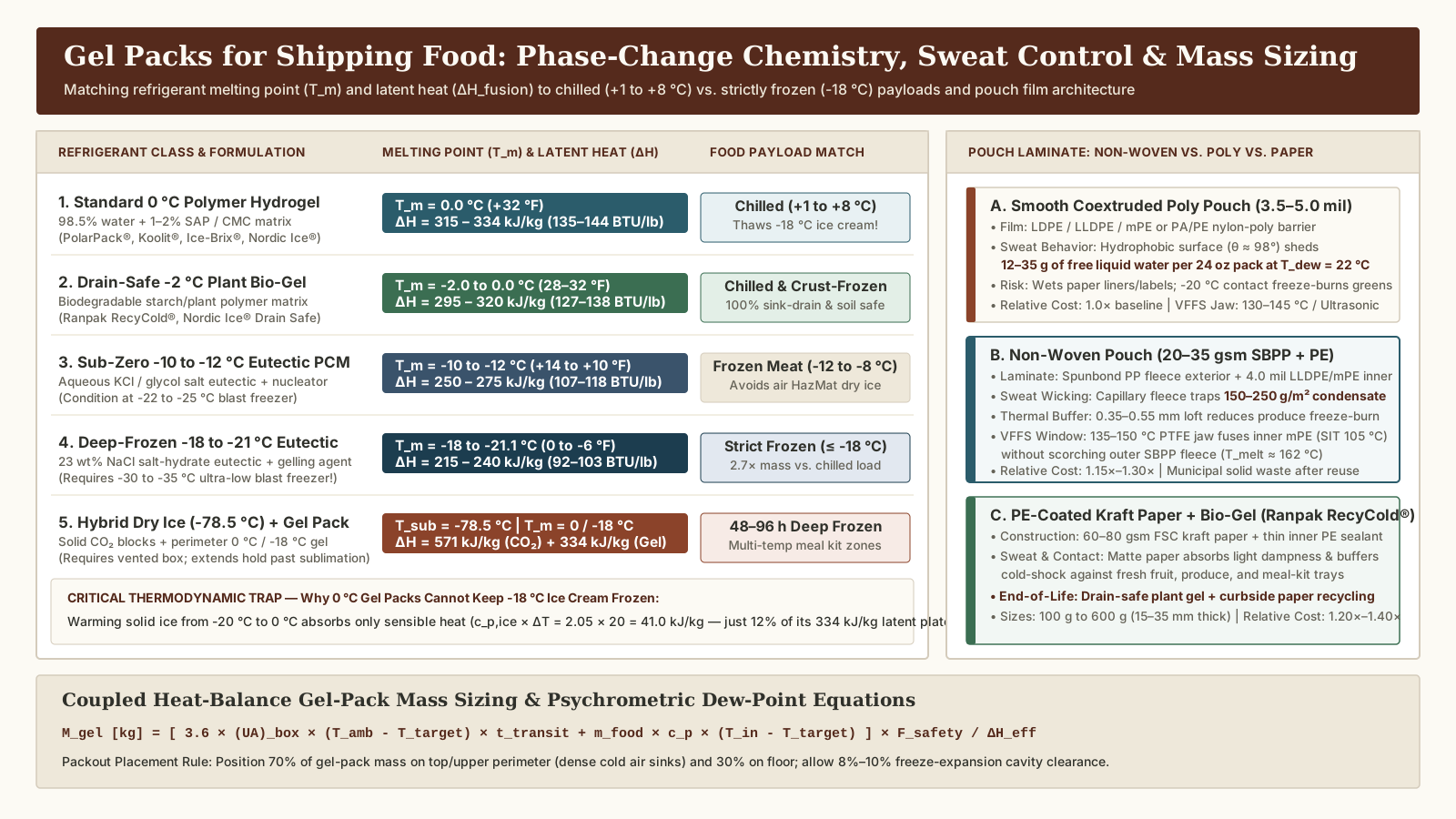
| Refrigerant Class & Commercial Examples | Phase-Change Melting Point (T_m) |
Latent Heat of Fusion (ΔH_fusion) |
Required Blast-Freezer Conditioning (T_pull) |
Target Food Payload & Thermodynamic Boundary |
|---|---|---|---|---|
1. Standard 0 °C (+32 °F) SAP / CMC Water Hydrogel98.0%–99.2% purified water + 0.8%–2.0% sodium polyacrylate or carboxymethyl cellulose (Sonoco ThermoSafe® PolarPack®, Pelton Shepherd Ice-Brix® / Glacier®, Cold Chain Tech Koolit®, Nordic Ice®) |
0.0 °C( +32.0 °F) |
315 – 334 kJ/kg( 135 – 144 BTU/lb) |
Freeze solid at -17 °C to -20 °C (0 °F to -4 °F) for 24–48 h (or temper at +2 to +4 °C against freeze shock) |
Chilled perishables (+1 °C to +8 °C) (prepared meals, dairy, produce, fresh meat) or frozen-to-chilled meat transitions; cannot keep -18 °C ice cream frozen |
2. Drain-Safe / Plant-Based -2 °C Bio-Hydrogel Pack100% biodegradable starch/cellulose polymer gel (Ranpak RecyCold® Cool Packs, Nordic Ice® Drain Safe) |
-2.0 °C to 0.0 °C( +28.4 °F to +32.0 °F) |
295 – 320 kJ/kg( 127 – 138 BTU/lb) |
Freeze solid at -18 °C to -20 °C for ≥ 24 h with pallet layer spacer racks |
Chilled (+2 °C to +8 °C) & sub-zero crust-frozen (-2 °C to -5 °C) D2C food parcels (up to 48 h); 100% household sink-drain and garden-soil safe |
3. Mid-Sub-Zero -10 °C to -12 °C Eutectic Gel / BrickAqueous potassium chloride ( 13.6 wt% KCl) or glycol eutectic + gelling matrix + nucleator (Koolit® Sub-Zero PCM, Cryopak / Pelton Shepherd Eutectic) |
-10.0 °C to -12.0 °C( +14.0 °F to +10.4 °F) |
250 – 275 kJ/kg( 107 – 118 BTU/lb) |
Requires -22 °C to -25 °C (-8 °F to -13 °F) freezer (must pull ≥ 10 K below T_m to overcome supercooling) |
Hard-frozen meat, poultry, par-baked dough & seafood (-12 °C to -8 °C); eliminates hazardous-materials air freight surcharges |
4. Deep-Frozen -18 °C to -21 °C Eutectic Salt-Hydrate PCM~23.3 wt% NaCl or 19.5 wt% NH₄Cl aqueous eutectic + polymer thickener + 1%–2% borax nucleator |
-18.0 °C to -21.1 °C( 0.0 °F to -6.0 °F) |
215 – 240 kJ/kg( 92 – 103 BTU/lb) |
Requires -30 °C to -35 °C (-22 °F to -31 °F) ultra-low blast freezer (a standard -18 °C warehouse freezer CANNOT freeze a -21 °C eutectic!) |
Strictly frozen food & ice cream (≤ -18 °C / 0 °F for 24–48 h) without dry ice; delivers ~28%–35% lower latent heat per kg than 0 °C gel |
5. Hybrid Dry Ice (-78.5 °C) + 0 °C / -18 °C Gel BufferSolid CO₂ compressed blocks/slices + perimeter hydrogel packs (ThermoSafe® / Peli BioThermal™ hybrid packouts) |
-78.5 °C (sublimation)+ 0 °C / -18 °C (fusion) |
571 kJ/kg (dry ice)+ 334 kJ/kg (gel) |
Dry ice stored at -78.5 °C; companion gel packs conditioned at -20 °C |
48 h – 96 h deep-frozen parcels or dual-zone meal kits; dry ice holds -20 °C frozen core while gel packs buffer cavity after dry ice sublimates |
1. Why standard 0 °C (+32 °F) polymer hydrogel packs cannot hold -18 °C frozen food
As documented in Sonoco ThermoSafe’s PolarPack® refrigerant specifications and peer-reviewed phase-change material research synthesized by the International Institute of Refrigeration (IIR / IIFIIR), standard commercial food gel packs contain 98.0% to 99.2 wt% purified water immobilized within 0.8% to 2.0 wt% cross-linked sodium polyacrylate (SAP) or carboxymethyl cellulose (CMC) (plus trace preservatives and colorants).
The cross-linked polymer network does not depress water’s thermodynamic freezing point (T_m ≈ 0.0 °C to -1.0 °C). Instead, the polymer chains trap liquid water into a shear-thinning hydrogel (15,000 to 60,000 cP apparent viscosity at rest) so the pack retains uniform brick geometry as it thaws, suppresses internal natural-convection heat transfer, and prevents free liquid flooding if an outer pouch is nicked. Because purified water constitutes ~98.5% of the mass, a standard 0 °C gel pack absorbs ΔH_fusion = 315 to 334 kJ/kg (135 to 144 BTU/lb) exclusively while melting at its 0 °C (+32 °F) isothermal plateau.
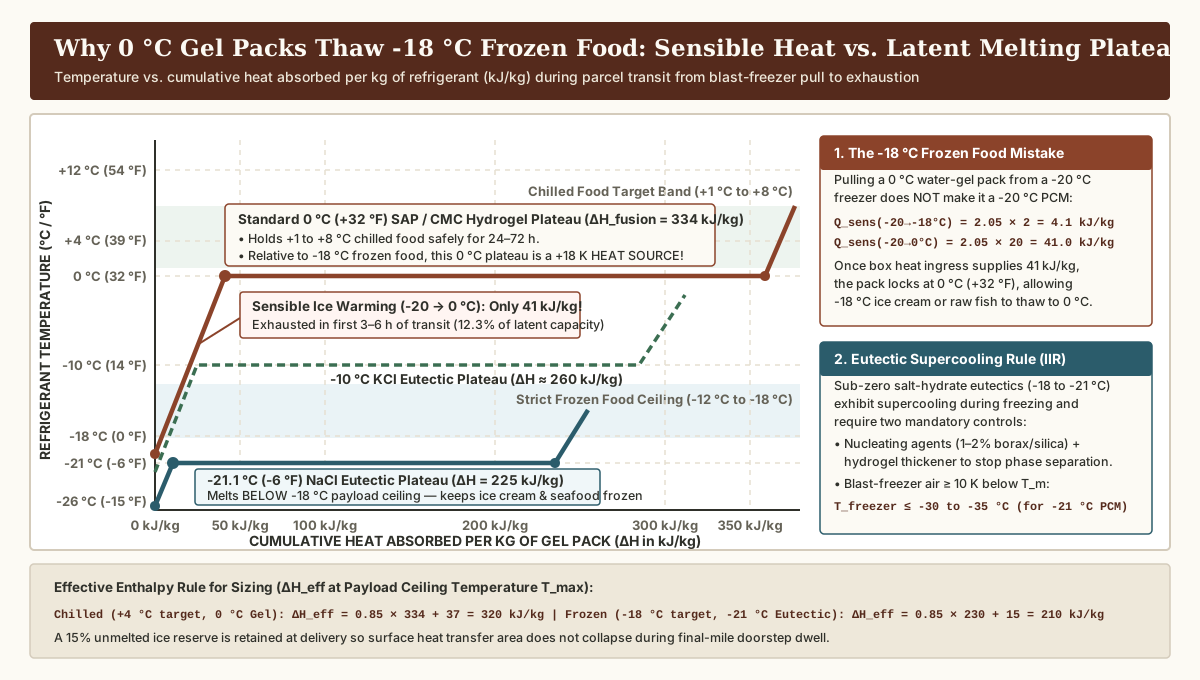
When a fulfillment center blast-freezes standard 0 °C hydrogel packs down to -20 °C (-4 °F) and packs them around strictly frozen food (-18 °C / 0 °F ice cream, gelato, or raw sushi-grade seafood), a critical thermodynamic reversal occurs:
- Sensible Ice Warming Only Below
0 °C(4.1 to 41.0 kJ/kg): Between-20 °Cand0 °C, a water-based hydrogel pack is already100%solid crystalline ice. It cannot undergo solid-to-liquid phase change below0 °C; it absorbs only the sensible heat of solid ice (c_p,ice ≈ 2.05 kJ/(kg·K)):
Q_sensible (-20 °C → -18 °C) = c_p,ice × ΔT = 2.05 kJ/(kg·K) × [ -18 - (-20) ] K = 4.10 kJ/kg

Q_sensible (-20 °C →   0 °C) = c_p,ice × ΔT = 2.05 kJ/(kg·K) × [   0 - (-20) ] K = 41.0 kJ/kg
= only 12.3% of its 334 kJ/kg latent plateau at 0 °C!- The
+18 KThermal Reversal at the0 °CPlateau: In a standard parcel shipper exposed to+30 °Cambient heat, conductive heat ingress supplies41.0 kJ/kgwithin the first3 to 6 hoursof transit, warming the0 °Cgel pack to its0 °C(+32 °F) melting point. For the remaining20 to 44 hoursof transit, the gel pack sits locked at0 °C—which is18 K(32.4 °F) warmer than the-18 °Cfrozen food payload. While a0 °Cgel pack successfully arrests thawed-but-chilled meat or poultry below the FDA Food Code+5 °C(41 °F) safety ceiling ("frozen-to-chilled" transition), it cannot prevent-18 °Cice cream, sorbet, or enzymatic raw seafood from warming and softening toward0 °C.
2. Sub-zero eutectic salt-hydrate PCMs (-10 °C to -21 °C) and supercooling control
To maintain strictly frozen food (≤ -12 °C to -18 °C) without hazardous-materials dry ice (solid CO₂ sublimating at -78.5 °C), packaging engineers specify sub-zero inorganic eutectic salt-hydrate or aqueous glycol Phase Change Materials (PCMs) documented by the International Institute of Refrigeration (IIR / IIFIIR). Dissolving a precise eutectic concentration of inorganic salt in water (such as 13.6 wt% KCl with T_m = -10.7 °C, 19.5 wt% NH₄Cl with T_m = -15.4 °C, or 23.3 wt% NaCl with T_m = -21.1 °C) creates a constant-freezing mixture that melts isothermally below -10 °C or -21 °C with a latent heat of ΔH_eutectic = 215 to 275 kJ/kg (92 to 118 BTU/lb).
As IIR’s cold-chain PCM synthesis (Soo et al., International Journal of Refrigeration, 2025) establishes, sub-zero salt-hydrate eutectics require two formulation and warehouse conditioning safeguards:
- Nucleating & Gelling Agents Against Supercooling and Phase Separation: Unmodified salt-water solutions suffer from supercooling (
remaining metastable liquid 5 K to 12 K below their nominal freezing point) and incongruent melting / salt settling over repeated freeze-thaw cycles. Commercial sub-zero eutectic packs incorporate1% to 2%heterogeneous nucleating agents (such as borax / sodium tetraborate or fumed silica) alongside cross-linked hydrogel or xanthan/CMC thickeners to lock salt ions in suspension. - Ultra-Low Blast-Freezer Pull Differential (
T_pull ≤ T_m - 10 K): A-21 °C(-6 °F) eutectic gel pack will never freeze inside a standard-18 °C(0 °F) frozen food warehouse. Overcoming nucleation hysteresis requires blast-freezer air at-30 °C to -35 °C(-22 °F to -31 °F) for24 to 48 hourswith open airflow channels between pallet layers.
Key Takeaway: Match the refrigerant’s melting point (
T_m) to sit2 K to 5 Kbelow the payload’s maximum allowable temperature ceiling (T_max). Use0 °C(+32 °F) polymer hydrogels (ΔH = 315–334 kJ/kg) or-2 °Cplant bio-gels (Ranpak RecyCold®) for+1 °C to +8 °Cchilled perishables, and specify-18 °C to -21 °Csub-zero eutectic PCMs (conditioned at -30 °C to -35 °C) or dry ice whenever frozen food must arrive hard-frozen at≤ -15 °C to -18 °C.
Calculate how many gel packs to ship frozen food and chilled perishables
To answer how many gel packs to ship frozen food versus chilled perishables without relying on trial-and-error guesswork, packaging engineers solve a three-term thermal energy balance across the assembled cold shipping box and food payload (supported by Sonoco ThermoSafe ISC Labs qualification methodology and Nordic Cold Chain Solutions’ small-format packout engineering).
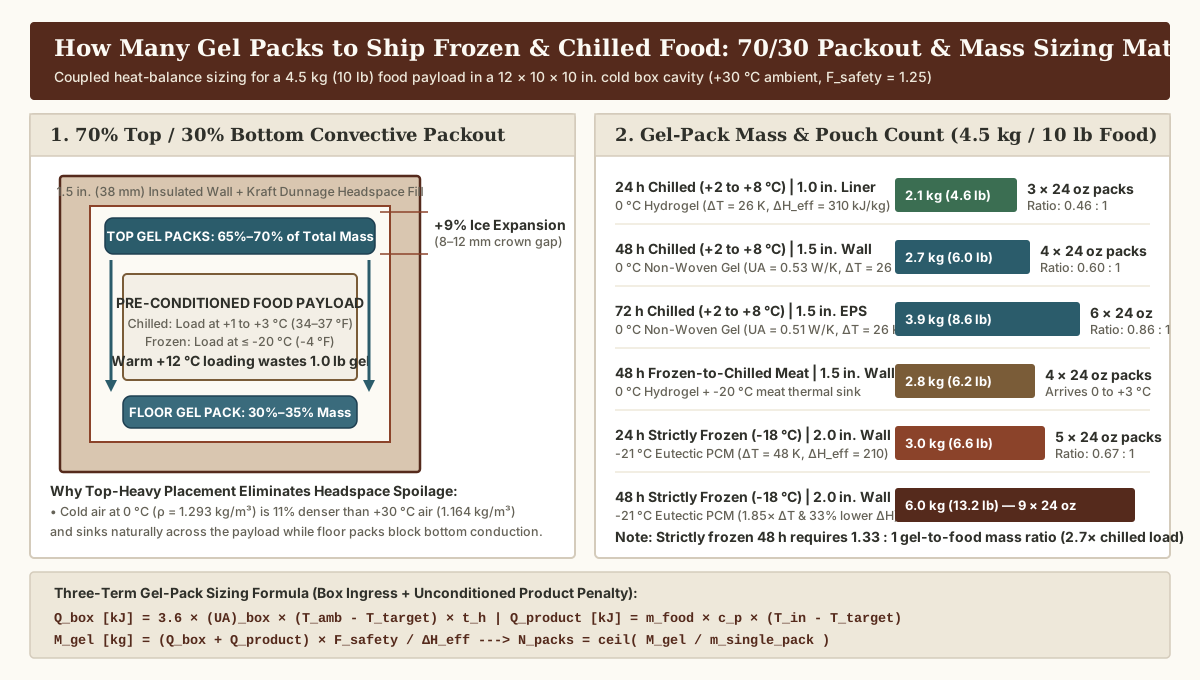
1. Coupled three-term heat-balance equation (Q_box + Q_product)
Term A — Enclosure Conduction and Seam Heat Ingress (Q_box)
From our cold shipping box R-value and 3D shape-factor derivation, an insulated container with wall conductivity k_SI (W/(m·K)), Langmuir 3D conduction shape factor S_3D = (A_int / t) + 0.54 × ΣL_edges,int + 1.20 × t (m), and seam bridging multiplier η_seam (1.07 for a 1-piece molded EPS chest, 1.15 for a 2-piece hinged paper/starch liner, or 1.28 for a 6-panel butt-jointed liner) exhibits a whole-box conductance (UA)_box = η_seam × k_SI × S_3D (W/K). Across a transit duration t_transit (hours) at mean external ambient temperature T_amb and target internal cavity temperature T_target:
Q_box [kJ] = 3.6 × (UA)_box [W/K] × (T_amb - T_target) [K] × t_transit [h]Term B — Unconditioned Product Precooling Deficit (Q_product)
If a food payload of mass m_food (kg) and specific heat capacity c_p,food (typically 3.2 to 3.8 kJ/(kg·K) above freezing for high-moisture meat, produce, and prepared meals, or 1.8 to 2.1 kJ/(kg·K) below freezing) enters the packing station at an incoming core temperature T_food,in > T_target, the gel packs must sacrifice latent enthalpy to pull down the warm payload:
Q_product [kJ] = m_food [kg] × c_p,food [kJ/(kg·K)] × max(0, T_food,in - T_target) [K]Why warm loading ruins hold time: Suppose an operator packs 5.0 kg (11.0 lb) of chilled prepared meals at T_food,in = +12.0 °C (53.6 °F, after staging on an unrefrigerated packing table) instead of pre-chilled at +2.0 °C (35.6 °F) for a T_target = +4.0 °C shipment. The precooling penalty is Q_product = 5.0 kg × 3.5 kJ/(kg·K) × (12.0 - 4.0) K = 140.0 kJ—which instantly melts 0.45 kg (1.0 lb) of 0 °C gel pack inside the closed box before the parcel ever leaves the loading dock.
Term C — Required Refrigerant Mass (M_gel) and Pouch Count (N_packs)
Dividing the combined thermal load by the gel pack’s effective enthalpy extraction capacity (ΔH_eff) at the payload’s upper temperature limit (T_max) and applying a transit safety factor F_safety = 1.20 to 1.25 (for hub sortation spikes and doorstep dwell) yields the total refrigerant mass and individual pouch count:
M_gel [kg] = [ (Q_box + Q_product) × F_safety ] / ΔH_eff [kJ/kg]

N_packs = ceil( M_gel [kg] / m_single_pack [kg] )
Where effective enthalpy ΔH_eff accounts for retaining a 15% unmelted solid ice core at final delivery (so the pouch surface area remains locked at T_m through the final hour):
- Chilled Perishables (
T_target = +4 °C,T_max = +8 °C) with0 °CHydrogel (conditioned at -18 °C): Utilizes36.9 kJ/kgof sensible ice warming (-18 °C to 0 °C) plus85%of its334 kJ/kglatent plateau (283.9 kJ/kg), deliveringΔH_eff,chilled ≈ 310 to 320 kJ/kg(133–138 BTU/lb). - Strictly Frozen Food (
T_target = -18 °C,T_max = -12 °C) with-21 °CEutectic PCM (conditioned at -32 °C): Utilizes~15 kJ/kgof sensible warming plus85%of its230 kJ/kgeutectic latent plateau (195.5 kJ/kg), deliveringΔH_eff,eutectic ≈ 205 to 215 kJ/kg(88–92 BTU/lb). Because the wall temperature differential across a-18 °Cfrozen box at+30 °Cambient isΔT_frozen = 30 - (-18) = 48 K—which is1.85×larger than theΔT_chilled = 30 - 4 = 26 Kdifferential of a chilled box—and because-21 °Ceutectic gel provides32%less effective enthalpy per kilogram (210vs.310 kJ/kg), shipping strictly frozen food with sub-zero eutectic gel packs requires2.6× to 2.8×more gel-pack mass than shipping an identical weight of chilled food.
2. Gel-pack sizing matrix (24 h, 48 h, 72 h) for a 4.5 kg (10 lb) food payload
The sizing matrix below applies the coupled heat-balance equation (F_safety = 1.25, +30 °C / 86 °F summer ambient, pre-conditioned payload with Q_product = 0) to a 12 × 10 × 10 in. (305 × 254 × 254 mm, 19.7 L) internal payload cavity using commercial pouch sizes from Sonoco ThermoSafe PolarPack® (12 oz / 340 g, 16 oz / 454 g, 24 oz / 680 g, 32 oz / 907 g, 48 oz / 1,360 g) and Ranpak RecyCold® (200 g, 400 g, 500 g, 600 g):
Shipment Profile & Enclosure Spec (12 × 10 × 10 in. Cavity) |
Pre-Conditioned Food Payload (m_food) |
Selected Refrigerant & Effective Enthalpy (ΔH_eff) |
Required Gel Mass (M_gel) & Standard Pouch Count |
Gel-to-Food Mass Ratio & Packout Placement |
|---|---|---|---|---|
1. Chilled Food (+2 to +8 °C) — 24 h Overnight1.0 in. (25 mm) KDF paper/starch liner (UA = 0.835 W/K, ΔT = 26 K, Q_box = 521 kJ) |
4.5 kg (10 lb) pre-chilled meals/produce at +2 °C |
Standard 0 °C Hydrogel (PolarPack® / Koolit®) or -2 °C RecyCold®( ΔH_eff = 310 kJ/kg) |
2.1 kg (4.6 lb)→ 3 × 24 oz (680 g) or 4 × 500 g packs |
0.46 : 1 (~1 lb gel per 2.2 lb food)2 packs (67%) on top, 1 pack (33%) on bottom |
2. Chilled Food (+2 to +8 °C) — 48 h 2-Day Regional1.5 in. (38 mm) Molded EPS or Hinged Bio-Liner (UA = 0.530 W/K, ΔT = 26 K, Q_box = 661 kJ) |
4.5 kg (10 lb) pre-chilled food at +2 °C |
Standard 0 °C Non-Woven Hydrogel Pack( ΔH_eff = 310 kJ/kg) |
2.7 kg (6.0 lb)→ 4 × 24 oz (680 g) or 3 × 32 oz (907 g) packs |
0.60 : 1 (~1 lb gel per 1.7 lb food)3 packs (75%) top/sides, 1 pack (25%) bottom |
3. Chilled Food (+2 to +8 °C) — 72 h 3-Day National1.5 in. (38 mm) Molded EPS Chest (UA = 0.513 W/K, ΔT = 26 K, Q_box = 960 kJ) |
4.5 kg (10 lb) pre-chilled food at +2 °C |
Standard 0 °C Non-Woven Hydrogel Pack( ΔH_eff = 310 kJ/kg) |
3.9 kg (8.6 lb)→ 6 × 24 oz (680 g) or 3 × 48 oz (1,360 g) packs |
0.86 : 1 (~1 lb gel per 1.15 lb food)70% top + upper sides, 30% floor |
4. Frozen-to-Chilled Meat (-20 °C pull → ≤ +4 °C arrival) — 48 h1.5 in. (38 mm) Molded EPS or Hinged Liner (UA = 0.530 W/K, mean ΔT = 32 K) |
4.5 kg (10 lb) blast-frozen meat/poultry at -20 °C (absorbs ~160 kJ sensible heat before 0 °C) |
Standard 0 °C Hydrogel Pack (conditioned at -20 °C)( ΔH_eff = 325 kJ/kg) |
2.8 kg (6.2 lb)→ 4 × 24 oz (680 g) or 3 × 32 oz (907 g) packs |
0.62 : 1 (meat arrives crust-frozen/chilled at 0 to +3 °C; never use for ice cream!) |
5. Strictly Frozen Food (≤ -15 to -18 °C) — 24 h & 48 h (No Dry Ice)2.0 in. (51 mm) Molded EPS or 1.5 in. PUR (UA = 0.380 W/K, ΔT = 48 K) |
4.5 kg (10 lb) deep-frozen food at -22 °C |
-21 °C (-6 °F) Eutectic Salt-Hydrate PCM Pack( ΔH_eff = 210 kJ/kg, conditioned at -32 °C) |
• 24 h: 3.0 kg (6.6 lb) (5 × 24 oz)• 48 h: 6.0 kg (13.2 lb) (9 × 24 oz or 5 × 48 oz) |
• 24 h: 0.67 : 1• 48 h: 1.33 : 1 (full 6-sided surround: 50% top, 30% sides, 20% floor) |
3. Top-down 70/30 convective placement and 9% freeze-expansion cavity clearance
Even when M_gel is sized accurately, two physical packout details govern whether the payload stays within specification:
- Allocate
65% to 70%of Gel-Pack Mass Above the Payload: Dry air at0 °C(ρ = 1.293 kg/m³) is11.1%denser than warm air at+30 °C(ρ = 1.164 kg/m³). If operators stack all gel packs underneath the food on the floor of the box, dense cold air pools at the bottom while heat conducting through the top carton flaps creates a stagnant+12 °C to +18 °Cheadspace pocket that spoils top-layer items. Placing65% to 70%of the gel-pack mass on top of (and around the upper perimeter of) the food payload drives natural downward buoyancy convection across the load, while30% to 35%on the floor intercepts conductive heat entering through the loaded bottom liner pad. - Allow
8% to 10%Vertical Clearance for Phase-Change Freeze Expansion: When liquid water crystallizes into hexagonal ice (Ice I_h), its density decreases from1,000 kg/m³to917 kg/m³—a9.05%volumetric expansion. Unless flexible pouches are frozen flat between rigid rack dividers (or specified as dimensional open-cell foam bricks such asSonoco ThermoSafe PolarPack® Foam Bricks,where water freezes inside a rigid phenolic/urethane foam skeleton), a flexible25 mm(1.0 in.) pouch crowns in the center to33 to 36 mm(1.3 to 1.4 in.). Always deduct this crowned frozen brick thickness when completing the insulated shipping boxes liner dimension and cavity fit worksheet so top liner flaps close flat without seam gaping.
Key Takeaway: Pre-chill or pre-freeze every food payload to its target storage temperature before packing (
warm loading at +12 °C melts ~0.45 kg of gel per 5 kg of food), allocate70%of gel packs on top and30%on the floor, and budget2.6× to 2.8×more gel-pack mass when switching from+4 °Cchilled hydrogels to-21 °Cfrozen eutectic packs.
Compare non-woven vs. poly gel pack pouches for condensation control and VFFS sealing
When packaging engineers evaluate a non woven vs poly gel pack specification (or compare PE-coated kraft paper pouches), they are managing two linked production interfaces: psychrometric dew-point condensation (“sweating”) inside the shipping carton and high-speed Vertical Form-Fill-Seal (VFFS) cross-seal jaw compatibility.
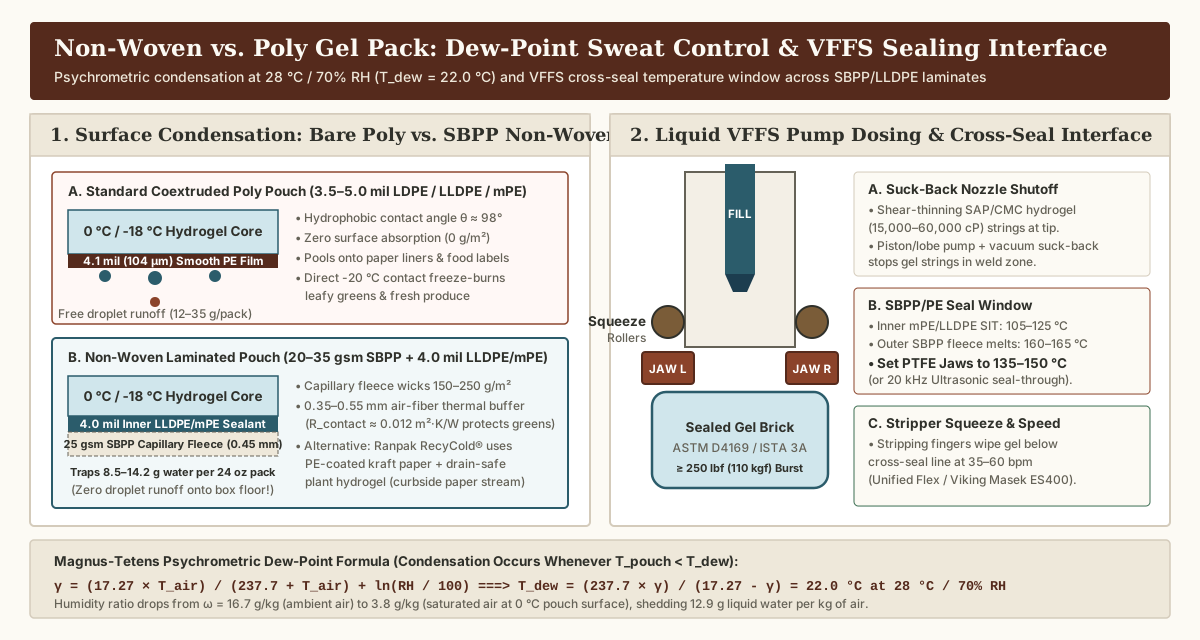
1. Psychrometric dew-point physics (T_dew) and condensate runoff math
As established in Compressed Air Best Practices’ food-packaging dew-point engineering analysis, the atmospheric dew point (T_dew) is the saturation temperature at which water vapor in air condenses into liquid water upon contacting any surface colder than T_dew (T_surface < T_dew). Using the Magnus-Tetens psychrometric approximation (a = 17.27, b = 237.7 °C) for ambient air at dry-bulb temperature T_air (°C) and relative humidity RH (%):
γ(T_air, RH) = (17.27 × T_air) / (237.7 + T_air) + ln(RH / 100)

T_dew [°C]   = (237.7 × γ) / (17.27 - γ)
Consider a summer food-fulfillment packing line or humid air infiltrating an unsealed carton seam at T_air = 28.0 °C (82.4 °F) and RH = 70%:
γ = (17.27 × 28.0) ÷ (237.7 + 28.0) + ln(0.70) = 1.8199 - 0.3567 = 1.4632T_dew = (237.7 × 1.4632) ÷ (17.27 - 1.4632) = 22.0 °C(71.6 °F)
Because a conditioned gel pack enters the packing station at a surface temperature of T_surface = -18 °C to +2 °C—which sits 20 K to 40 K below the 22.0 °C ambient dew point—water vapor in the boundary layer condenses immediately onto the pouch exterior (dropping the air's humidity ratio from ω_28°C,70% = 16.7 g H₂O/kg dry air down to ω_0°C,sat = 3.8 g/kg, shedding 12.9 g of liquid water per kilogram of contacted air). Across packing staging and a 24–48 h transit cycle, a single 24 oz (680 g, 8.0 × 5.5 in. / 203 × 140 mm, two-sided surface area A_pouch = 0.0568 m²) gel pack condenses 12 g to 35 g (12 to 35 mL) of liquid water.
2. Pouch laminate comparison: bare poly vs. spunbond non-woven vs. PE-coated kraft paper
As documented by Pelton Shepherd Industries (Glacier Moisture-Guard® and Ice-Brix®), Cold Chain Technologies (Koolit® refrigerant series), Nordic Cold Chain Solutions (Nordic Ice® No Sweat), and Ranpak (RecyCold® paper-pouch cool packs), the outer pouch substrate governs where that 12 to 35 g of condensate goes:
| Pouch Construction & Commercial Examples | Outer Surface & Condensate Handling (at T_dew = 22 °C) |
Thermal Contact Shock & Puncture Resistance | Relative Cost & End-of-Life Disposal Pathway |
|---|---|---|---|
1. Standard Coextruded Poly Film Pouch3.5 – 5.0 mil (90 – 125 µm) LDPE / LLDPE / Metallocene PE (or PA/PE nylon-poly for heavy > 32 oz packs)(ThermoSafe® PolarPack®, Koolit® Poly, Nordic Ice® Regular) |
Smooth hydrophobic PE surface (contact angle θ ≈ 98°); condensed vapor beads into droplets that coalesce and run off (0 g/m² absorption) onto box floors and food labels |
Bare 0.10 mm film (R_contact ≈ 0.0003 m²·K/W) causes localized -20 °C contact freeze-burn on leafy greens, berries, and herbs unless separated by corrugated dunnage |
1.0× baseline cost; reusable; never pour SAP hydrogel down drains (clogs plumbing); gel-soiled poly pouches go to municipal solid waste |
2. Spunbond Non-Woven Laminated Pouch20 – 35 g/m² (gsm) SBPP (spunbond polypropylene) fleece laminated to 3.5 – 4.5 mil LLDPE/mPE inner barrier film(Pelton Shepherd Glacier Moisture-Guard®, Polar Tech Ice-Brix® Moisture Safe, Nordic Ice® No Sweat) |
Micro-porous capillary fiber matrix wicks and locks 150 – 250 g/m² of surface sweat (trapping 8.5 to 14.2 g per 24 oz pouch in place without dripping) |
0.35 – 0.55 mm air-filled fiber loft (R_contact ≈ 0.012 m²·K/W) buffers initial -20 °C skin-contact shock against produce/floral/cheese and increases carton-corner puncture resistance |
1.15× – 1.30× poly cost; eliminates separate absorbent pads and bagging labor; multi-material PP + PE laminate is not curbside film recyclable (municipal waste after reuse) |
3. PE-Coated Kraft Paper Pouch + Bio-Gel60 – 80 gsm virgin FSC kraft paper + thin internal PE/LDPE heat-seal moisture barrier (100 g to 600 g sizes)(Ranpak RecyCold® Cool Packs) |
Matte kraft paper outer face absorbs light surface dampness while inner PE coating contains the plant hydrogel (up to 48 h transit hold) |
Paper skin moderates cold-contact shock (preventing fruit and produce bruising); lower hydraulic burst ceiling under heavy bulk drop loads than nylon-poly PA/PE |
1.20× – 1.40× poly cost; 100% biodegradable plant gel pours safely into sink drain or garden soil; empty paper pouch recycles in curbside paper stream |
| 4. Semi-Rigid Open-Cell Foam Brick (Poly-Wrapped) Rigid open-cell phenolic/urethane foam block saturated with water/PCM and sealed in 4.0 mil PE film(ThermoSafe® PolarPack® Foam Bricks) |
Smooth PE outer wrap (sweats like standard poly), but internal rigid foam skeleton immobilizes water even if punctured |
Zero freeze-expansion crowning (< 1 mm bulge) when frozen in pallet loads; maintains exact rectangular brick tolerances |
1.35× – 1.60× poly cost; specified for tight-clearance dimensional cavities (specialty food & diagnostic kits) where pouch pillowing prevents lid closure |
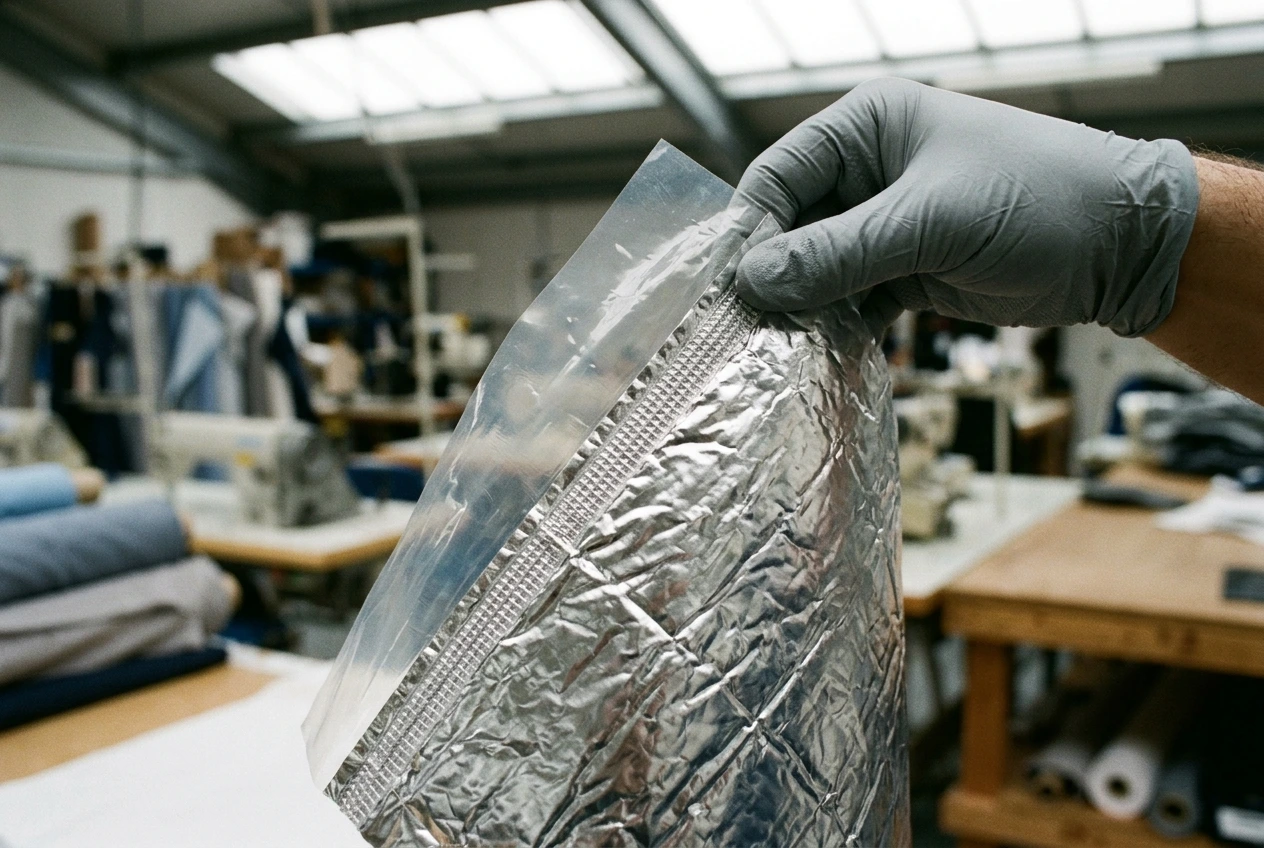
When packing inside moisture-sensitive curbside-recyclable paper or starch-kraft box liners (such as Ranpak RecyCold® climaliner™, TemperPack ClimaCell®, or Sonoco ThermoSafe EOS™, see insulated liner converting), free liquid runoff from bare poly gel packs wets the kraft liner facing and degrades structural compression strength. Specifying 20–35 gsm non-woven moisture-guard gel packs or PE-coated kraft paper cool packs prevents liquid pooling without adding a secondary plastic inner bag.
3. Liquid VFFS machinery (Unified Flex & Viking Masek): pump dosing and cross-sealing through hydrogel
Manufacturing leak-proof gel packs for shipping food from rollstock on high-speed liquid Vertical Form-Fill-Seal (VFFS) machinery—such as the Unified Flex Vertobagger 2.0, Vertobagger Ultrasonic, and Falcon liquid/gel baggers or the Viking Masek ES400 sanitary washdown VFFS (operating at up to 60 bags/min on rollstock widths up to 850 mm / 33.46 in. with IP66 washdown enclosures)—requires controlling three mechanical and thermal variables across the sealing interface:
- Incoming Web Slitting Tension and Delamination Prevention:
Before rollstock reaches the VFFS forming collar,
20–35 gsm SBPP non-woven / 4.0 mil LLDPElaminates andPE-coated kraftwebs must be slit and rewound without stretching the extensible PE sealant layer against the non-woven fleece (which causes curl and vertical fin-seal tracking errors; see ourslitting and rewinding machine setup guide). - Positive-Displacement Hydrogel Dosing & Vacuum Suck-Back Shutoff:
Hydrated
SAPorCMCgel is strongly non-Newtonian (shear-thinning) and pulls into long viscoelastic strings when a nozzle closes. If a single hydrogel filament bridges the horizontal cross-seal area, water flashes to steam under the heated jaws and leaves a capillary channel leak that bursts underASTM D4169 / ISTA 3Aparcel drop and stack compression loads. Industrial liquid VFFS lines prevent seal contamination using:- Servo Piston or Rotary Lobe Positive-Displacement Pumps discharging through an internal fill pipe that extends below the VFFS forming collar, equipped with a pneumatic positive-shutoff valve and vacuum suck-back tip that retracts the liquid meniscus at the end of each stroke; or
- Two-Stream In-Line Dosing, which meters dry
SAPpolymer powder via servo auger alongside chilled water directly into the open pouch tube so filling occurs at water-like1 cPviscosity before cross-linking into a solid gel within30 to 90 secondsafter sealing.
- Pneumatic Stripping Rollers & The
135 °C – 150 °CNon-Woven Seal Window: Immediately above the horizontal cross-seal jaws, pneumatic stripping squeeze rollers (wiper fingers) close on the film tube and strip viscous hydrogel downward out of the seal zone (producing a low-headspace pillow pack that absorbs hydraulic drop shock).- Sealing Through Wet Film (
Metallocene LLDPE+ Impulse or20 kHzUltrasonic Jaws): Specifying an inner sealant layer of metallocene linear low-density polyethylene (mPE / mLLDPE, octene or hexene copolymer) lowers the seal initiation temperature (SIT) to95 °C – 105 °Cand delivers high hot-tack strength capable of sealing through trace moisture. Systems such as the Unified FlexVertobagger Ultrasonicapply20 kHzultrasonic horn vibration under high clamping force (4.5 to 6.0 bar) to acoustically displace residual hydrogel out of the6 to 10 mmweld interface before frictionally fusing the inner polymer. - Preventing Scorch on Non-Woven
SBPP / LLDPELaminates: As detailed in our industrial bag sealer trial guide, the outer spunbond polypropylene (SBPP) fleece melts at160 °C to 165 °C, whereas the innermPE / LLDPEsealant fuses at105 °C to 125 °C. Because the0.45 mmair-filled non-woven fleece acts as a thermal insulator between the heated VFFS jaw and the inner sealant web, operators must maintain a tightly controlled jaw temperature window of135 °C to 150 °Cwith PTFE-coated glass barrier tape and350 to 600 msdwell—hot enough to conduct through the fleece and fuse the innerLLDPElayer, but12 K to 25 Kbelow the162 °Cmelting point of the outer polypropylene fibers so the fleece never scorches or sticks to the jaws.
- Sealing Through Wet Film (
Key Takeaway: Specify
20–35 gsmnon-woven laminated gel packs (150–250 g/m²moisture capture) or PE-coated kraft paper cool packs (Ranpak RecyCold®) whenever shipping inside paper/starch liners or alongside moisture-sensitive food labels and fresh produce. On liquid VFFS lines, pair vacuum suck-back nozzles and stripping squeeze rollers with a135 °C to 150 °Cjaw window to fuse the innermPE/LLDPEsealant without melting the outer162 °Cpolypropylene fleece.
Run a four-gate refrigerant and pouch qualification before releasing the packout
Before locking a cold-chain food packout specification or releasing an in-house VFFS gel-pack production run, execute this four-gate verification sequence (combining ThermoSafe ISC Labs’ ISTA 7D / 7E chamber methodology, Cold Chain Technologies’ disposal rules, and liner cavity fit checks):
| Verification Gate | Engineering Parameter to Record | Acceptance Threshold & Mandatory Stop Rule |
|---|---|---|
Gate 1: Phase-Change Melting Point (T_m) & Blast-Freezer Conditioning Check |
Record refrigerant formulation (0 °C SAP/CMC hydrogel, -2 °C RecyCold® plant gel, or -10 °C / -21 °C eutectic salt PCM), latent heat (ΔH_fusion), and blast-freezer air temperature + dwell duration (≥ 24–48 h with pallet spacer racks). |
Stop Rule: Never specify 0 °C (+32 °F) water-gel packs alone to ship strictly frozen food (-18 °C ice cream or raw seafood that cannot warm toward 0 °C), and never condition a -21 °C eutectic pack in a standard -18 °C warehouse freezer (blast-freezer air must pull ≥ 10 K below T_m, i.e., -30 °C to -35 °C, to overcome eutectic supercooling). Verify solid core freeze completion with a contact thermocouple before staging. |
| Gate 2: Psychrometric Dew-Point Sweat & Pouch Laminate Selection | Record worst-case lane ambient dew point (T_dew = 22.0 °C at 28 °C / 70% RH), adjacent payload moisture sensitivity (paper food labels, dry bakery cartons, fresh produce), box liner material (paper/starch vs. EPS), and pouch outer substrate (4.1 mil poly vs. 25 gsm SBPP non-woven/PE vs. PE-coated kraft paper). |
Stop Rule: If the cold shipping box uses an unlined paper, starch (ClimaCell®), or fluted kraft (RecyCold® climaliner™) wall—or contains unlaminated paper food labels or fresh produce—reject bare smooth poly pouches unless isolated inside a sealed poly liner bag; specify 20–35 gsm non-woven moisture-guard pouches (150–250 g/m² wicking capacity) or paper-skinned cool packs. |
Gate 3: Pre-Chill Payload Gate, 70/30 Placement & 9% Expansion Fit |
Record incoming food core temperature at the packing table (T_food,in), derated box conductance (UA)_box (per cold shipping box R-value guide), total gel mass (M_gel), top-to-bottom mass split (70% top / 30% floor), and frozen brick thickness including 8%–10% freeze expansion (per liner dimension worksheet). |
Stop Rule: Reject any food lot arriving at the packing station > 2 °C warmer than its target storage temperature (which consumes latent gel capacity before shipping). Reject any packout placing > 50% of gel packs on the bottom floor or where frozen pouch crowning forces top carton flaps to bulge by > 3 mm. |
Gate 4: VFFS Cross-Seal Burst Integrity (ASTM D4169 / ISTA 3A) & End-of-Life Labeling |
For VFFS pouch converting (Unified Flex / Viking Masek), record laminate gauge (mPE/LLDPE vs. PA/PE vs. SBPP/PE), jaw temperature (135–150 °C), stripper-roller gap, and static plate compression test result (≥ 110–150 kgf / 250–330 lbf held for 60 s). Verify consumer disposal instructions printed on the pouch. |
Stop Rule: Reject any VFFS lot exhibiting hydrogel strings in the cross-seal or seal weeping/delamination under 250 lbf (110 kgf) static compression (per bag sealer trial guide). Never instruct consumers to pour sodium polyacrylate (SAP) hydrogel down household drains (only certified biodegradable plant hydrogels such as Ranpak RecyCold® or Drain-Safe formulations are sink-safe). |
Key Takeaway: Approve the refrigerant chemistry, pouch laminate, and box liner as a single coupled system: verify solid blast-freezer conditioning (
≥ 10 K below T_m), enforce the incoming food pre-chill gate, pressure-test VFFS cross-seals to≥ 250 lbf(110 kgf), and qualify minimum and maximum payload packouts underISTA 7DorISTA 7Ethermal chamber profiles.
Technical basis and scope
Phase-change refrigerant specifications, pouch film architectures, and liquid VFFS machinery parameters in this guide are grounded in published technical documentation and peer-reviewed cold-chain literature from Sonoco ThermoSafe® (PolarPack® Gel Packs, PolarPack® Foam Bricks, and ISC Labs™ ISTA 7D / 7E Qualification), the International Institute of Refrigeration (IIR / IIFIIR) and International Journal of Refrigeration (Soo et al., 2025 review of organic, inorganic eutectic, and polymer hydrogel PCMs), Pelton Shepherd Industries (Glacier Moisture-Guard® and Ice-Brix® gel packs), Cold Chain Technologies (Koolit® refrigerants and end-of-life disposal guidance), Pharmaceutical Commerce / Nordic Cold Chain Solutions (Nordic Ice® Regular, No-Sweat, and Drain-Safe packouts), Packaging Europe / Ranpak (RecyCold® biodegradable plant-gel cool packs and climaliner™), Compressed Air Best Practices (psychrometric dew-point and surface condensation physics), and Unified Flex Packaging Technologies / Viking Masek (liquid and gel VFFS baggers). Coupled heat-balance sizing equations, psychrometric condensation calculations, and VFFS jaw temperature windows represent engineering planning models governed by enclosure conductance, ambient lane exposure, and laminate film grade; always qualify final production packouts through calibrated chamber and transit lane testing (see our editorial policy).