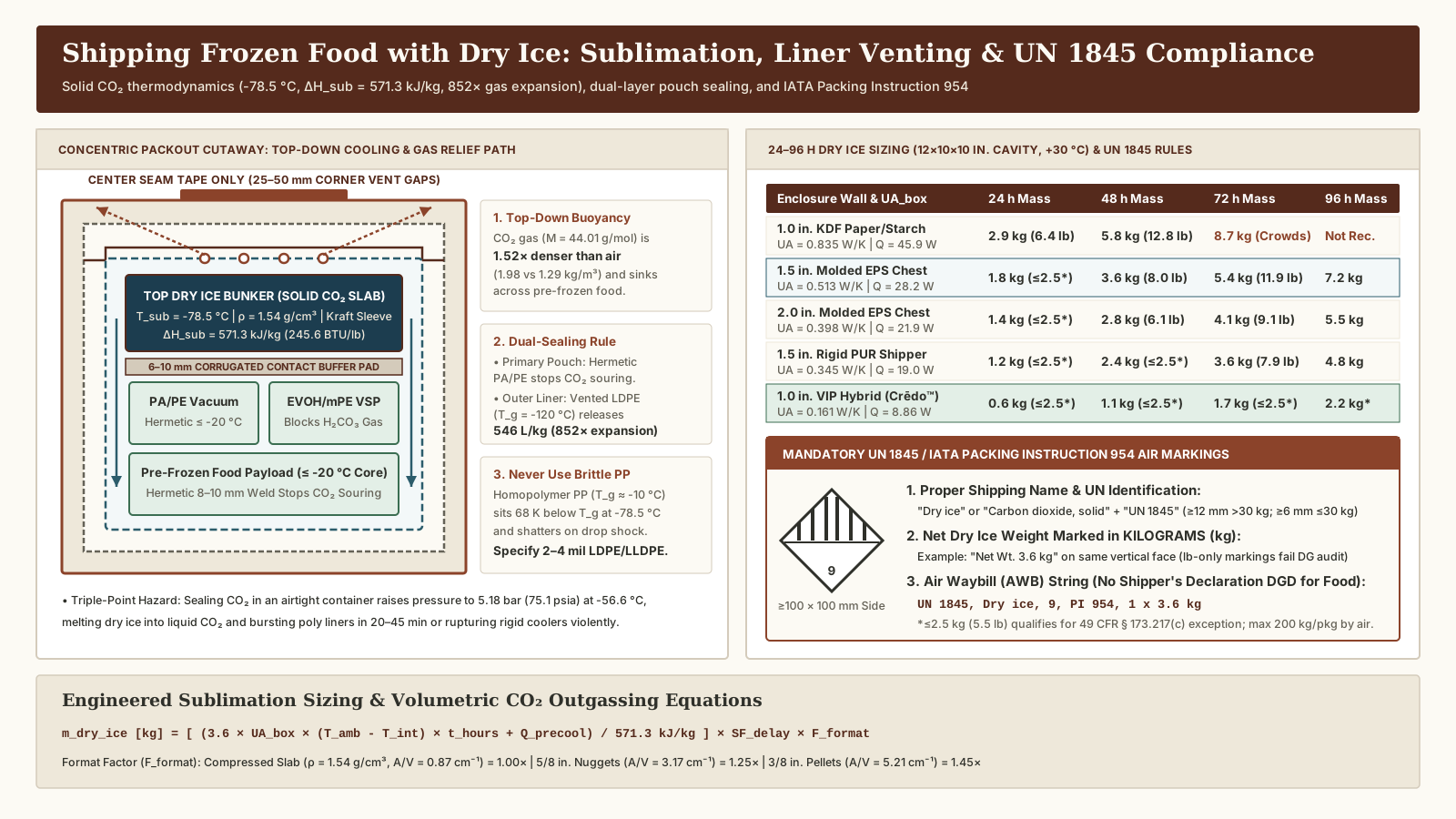
Engineering a parcel packout for shipping frozen food with dry ice requires managing a simultaneous thermal, mechanical, and dangerous-goods problem: solid carbon dioxide (CO₂) sublimates at -78.5 °C (-109.3 °F) while expanding 852× in volume into cold gas (546 L/kg at 20 °C). If operators run the outer box liner through a continuous airtight band sealer, sublimating gas inflates and ruptures the polyethylene weld within 20 to 45 minutes, causing seam failure, carton damage, and carrier dangerous-goods rejection. Conversely, if the primary food pouches inside the cooler are left unsealed, the 85% to 99% CO₂ cavity atmosphere dissolves into food moisture to form carbonic acid (H₂CO₃), carbonating fruit, turning raw meat brown, and souring dairy. Determining how much dry ice to ship frozen food across 24 h to 96 h parcel lanes and meeting un1845 dry ice packaging requirements under IATA Packing Instruction 954 (PI 954) and 49 CFR § 173.217 requires coupling enclosure conductance (UA_box), dual-layer polymer sealing (T_g selection), and vertical-face kilogram (kg) net weight declarations.
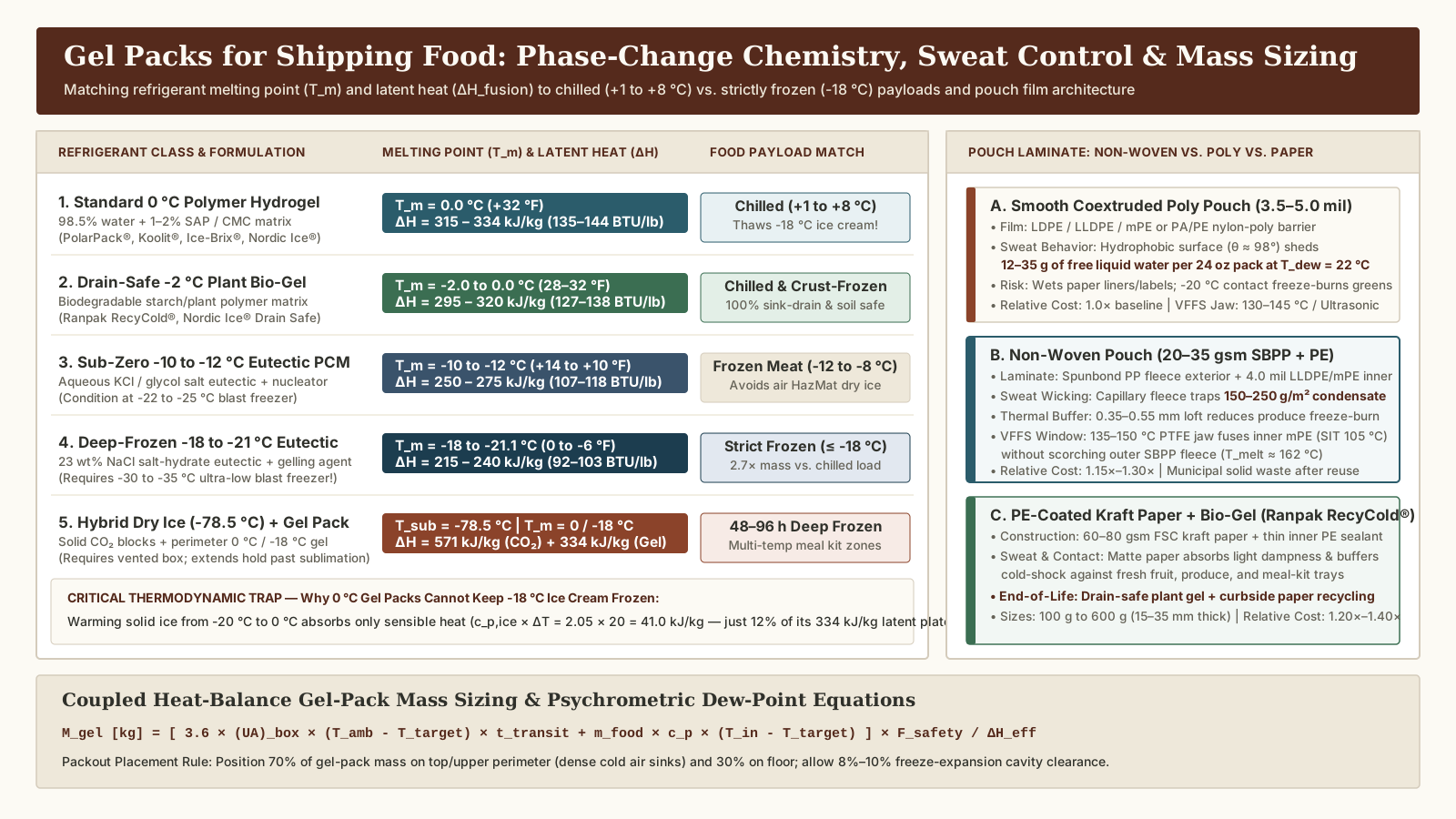
Within our insulated packaging machinery engineering series, our temperature-controlled packaging types overview separates the outer corrugated container, thermal insulation core, and phase-change refrigerant subsystem, while our cold shipping boxes R-value and wall material comparison derives whole-box conductance (UA_box) across 1.0 in. to 2.0 in. walls and our gel packs for shipping food guide covers 0 °C hydrogels and -21 °C eutectic packs. This companion specification addresses cryogenic -78.5 °C solid CO₂ packouts: replacing the generic 5–10 lb / 24 h rule of thumb with wall-specific sublimation math, comparing compressed blocks against extruded pellets, configuring hermetic primary food bag sealers alongside vented outer gusseted and die-cut box liners, and executing a four-gate UN 1845 inspection before carrier handoff.
Calculate how much dry ice to ship frozen food: sublimation thermodynamics and 24–96 hour sizing
When packaging engineers calculate how much dry ice to ship frozen food (≤ -18 °C / 0 °F steaks, seafood, ice cream, and flash-frozen bakery items), generic carrier advice to pack "5 to 10 lb (2.3 to 4.5 kg) of dry ice per 24 hours" only describes a mid-thickness 1.5 in. (38 mm) molded Expanded Polystyrene (EPS) cooler in moderate weather. As documented in Sonoco ThermoSafe’s 2025 dry ice market and sublimation engineering analysis and Peli BioThermal’s ultra-low-temperature dry ice shipper portfolio, daily dry ice consumption ranges from 3% to 10%+ of total coolant mass per 24 hours depending on enclosure conductance (UA_box), external ambient temperature (T_amb), and dry ice geometry (compressed slabs versus extruded pellets).
1. Sublimation latent heat (571.3 kJ/kg), volumetric gas expansion (852×), and downward buoyancy
At standard atmospheric pressure (1 atm = 101.325 kPa), carbon dioxide has no liquid phase; solid dry ice sublimates directly from a crystalline solid into cold CO₂ vapor:
- Isothermal Sublimation Point and Latent Enthalpy (
ΔH_sub): SolidCO₂sublimates isothermally atT_sub = -78.5 °C(-109.3 °F/194.65 K) with a latent heat of sublimation ofΔH_sub = 571.3 kJ/kg(245.6 BTU/lb). Per kilogram of refrigerant, dry ice absorbs1.71×more latent heat than0 °Cwater-based gel packs (ΔH_fusion = 334 kJ/kg) and2.48×more latent heat than-21 °Ceutectic salt-hydrate packs (ΔH_fusion ≈ 230 kJ/kg, detailed in our gel pack phase-change comparison). As sublimatedCO₂vapor (specific heat c_p,gas ≈ 0.79 kJ/(kg·K)) warms from-78.5 °Ctoward a-20 °Ccavity boundary before venting through the lid, it absorbs an additional~46.2 kJ/kg(19.9 BTU/lb) of sensible gas heat, which packaging engineers retain as an uncredited thermal safety reserve. - Volumetric Expansion (
1.00 kg Solid → 509 to 556 L Gas): Compressed block dry ice has a solid density ofρ_solid = 1.50 to 1.56 g/cm³(93.6 to 97.4 lb/ft³), meaning1.00 kgof solid slab occupies just0.641 L(39.1 in³). Because the molar mass ofCO₂isM_CO2 = 44.01 g/mol,1.00 kg(1,000 g) equalsn = 1,000 ÷ 44.01 = 22.722 molof gas. By the ideal gas law (V = n × R × T / PatP = 101.325 kPa),1.00 kgof dry ice expands upon sublimation to:509 L(18.0 ft³) at0 °C(273.15 K), representing a794×volumetric expansion over the solid block,546 L(19.3 ft³) at20 °C(293.15 K), representing an852×volumetric expansion (248 Lor8.75 ft³per1 lb), and556 L(19.6 ft³) at25 °C(298.15 K), representing an867×volumetric expansion.
- Why Dry Ice Must Be Placed on Top of the Payload (
1.52×Air Density): Because the molecular weight ofCO₂(44.01 g/mol) is1.52×heavier than dry air (28.97 g/mol), coldCO₂gas has a density of1.977 kg/m³at0 °C(and ~2.80 kg/m³ at -78.5 °C) compared to1.293 kg/m³for0 °Cair. SublimatingCO₂vapor sinks rapidly to the floor of the shipping box by natural buoyancy convection. Placing dry ice slabs or nuggets on top of the pre-frozen food payload (separated by a 6 to 10 mm single-wall corrugated buffer pad to prevent -78.5 °C contact freezer burn on primary pouches) bathe the entire payload height in sinking sub-zero gas. Placing dry ice solely on the bottom floor strands dense cold gas at the base while the top layer of frozen food thaws under the carton flaps.
2. Engineered dry ice sizing equation vs. the 5–10 lb / 24 h rule of thumb
From our cold shipping boxes R-value and 3D shape-factor derivation, an assembled insulated container inside protective mailers and boxes has a whole-box thermal conductance (UA)_box = η_seam × k_SI × S_3D (W/K), where k_SI is the wall material’s ASTM C518 thermal conductivity (W/(m·K)), S_3D is Langmuir’s 3D box conduction shape factor (m), and η_seam is the corner/lid seam bridging multiplier (1.07 for a 1-piece molded EPS chest or 1.15 for a 2-piece hinged liner).
When maintaining an internal frozen cavity mean temperature of T_int = -25 °C (so the food core stays safely ≤ -18 °C throughout transit) against an external summer design ambient of T_amb = +30 °C (86 °F, ΔT = 30 - (-25) = 55 K), steady-state heat ingress (Q_dot), steady sublimation rate (dm_sub/dt), and total required packout dry ice mass (m_dry_ice) follow:
Q_dot [W]        = (UA)_box [W/K] × (T_amb - T_int) [K]

Q_total [kJ]     = 3.6 × Q_dot [W] × t_hours [h] + Q_precool [kJ]

dm_sub/dt [kg/h] = (3.6 × Q_dot [W] / 571.3 [kJ/kg]) × F_format = 0.00630 × Q_dot × F_format

m_dry_ice [kg]   = (Q_total [kJ] / 571.3 [kJ/kg]) × SF_delay × F_format
Where:
Q_precool = m_food × c_p,frozen × max(0, T_food,in - T_target)(equals 0 kJ when the payload is blast-frozen to ≤ -20 °C prior to packing),SF_delay = 1.25is a25%transit and hub-dwell buffer (recommended bySonoco ThermoSafeto protect against tarmac holds and last-mile porch exposure), andF_formatis the dry-ice geometry sublimation multiplier (1.00for sliced compressed slabs,1.20–1.30for5/8 in.nuggets, and1.35–1.55for3/8 in.high-surface pellets).
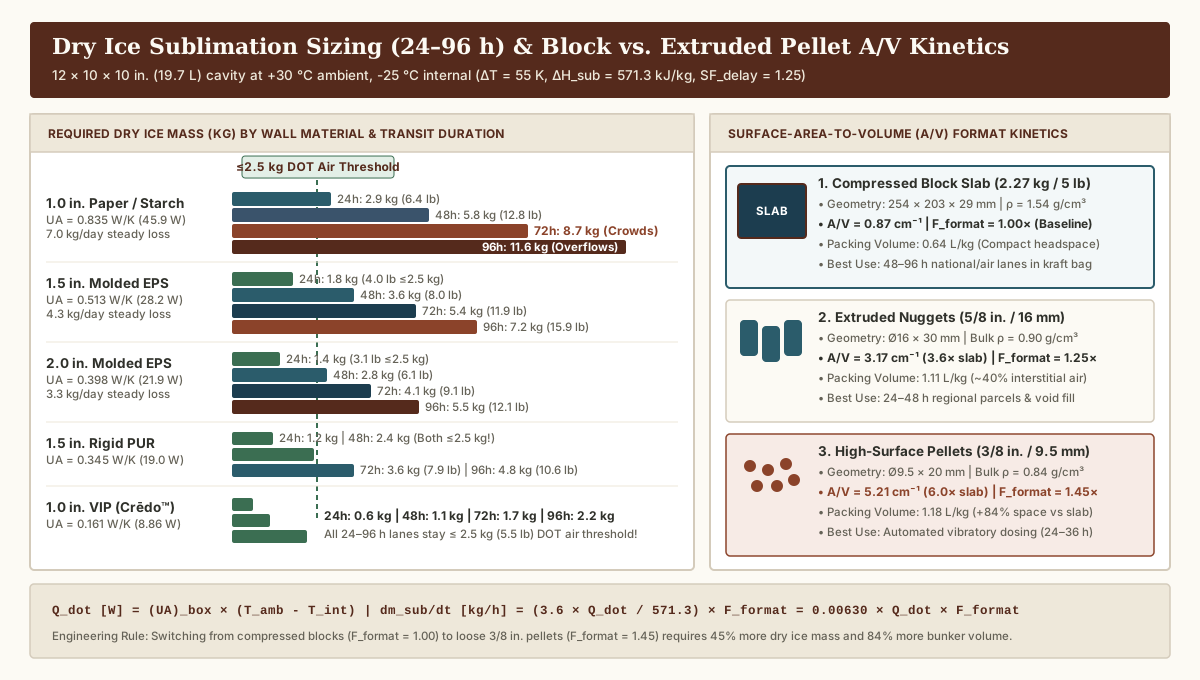
Every 1.0 W of conductive heat entering the enclosure sublimates 0.00630 kg/h (0.151 kg/day or 0.333 lb/day) of compressed block dry ice before applying SF_delay. The 24-to-96-hour sizing matrix below applies this equation (ΔT = 55 K, SF_delay = 1.25, F_format = 1.00 for sliced blocks) to the standardized 12 × 10 × 10 in. (305 × 254 × 254 mm, 19.7 L) internal payload cavity (verify net usable cavity after wall and fold deductions using our insulated shipping boxes dimension worksheet):
Enclosure Wall Construction (12 × 10 × 10 in. Cavity) |
Derated Box Conductance (UA)_box & Heat Load Q_dot (ΔT = 55 K) |
24 h Overnight Dry Ice Mass (SF = 1.25) |
48 h 2-Day Dry Ice Mass (SF = 1.25) |
72 h 3-Day Dry Ice Mass (SF = 1.25) |
96 h 4-Day Dry Ice Mass (SF = 1.25) |
Cavity Fit & Regulatory Threshold Assessment |
|---|---|---|---|---|---|---|
1. 1.0 in. (25.4 mm) KDF Paper / Starch Liner(ClimaCell® / RecyCold®, k = 0.039 W/(m·K), η_seam = 1.15) |
0.835 W/KQ_dot = 45.9 W( 6.95 kg/d steady) |
2.9 kg( 6.4 lb)1.9 L slab |
5.8 kg( 12.8 lb)3.7 L slab |
8.7 kg( 19.2 lb)5.6 L slab |
Not Rec. ( 11.6 kg / 25.6 lb overflows cavity) |
Viable for 24–48 h regional frozen lanes; at 72 h, dry ice + dunnage occupies > 45% of the 19.7 L cavity |
2. 1.5 in. (38.1 mm) Molded EPS Chest(Sherpa™ DeepFreeze / Envoy, k = 0.036 W/(m·K), η_seam = 1.07) |
0.513 W/KQ_dot = 28.2 W( 4.27 kg/d steady) |
1.8 kg( 4.0 lb)≤ 2.5 kg DOT! |
3.6 kg( 8.0 lb)2.3 L slab |
5.4 kg( 11.9 lb)3.5 L slab |
7.2 kg( 15.9 lb)4.6 L slab |
Industry benchmark (~4 lb / 24 h); qualifies for ≤ 2.5 kg 49 CFR § 173.217(c) threshold on 24 h overnight lanes |
3. 2.0 in. (50.8 mm) Molded EPS Chest( k = 0.035 W/(m·K), R_slab = 8.2, η_seam = 1.07) |
0.398 W/KQ_dot = 21.9 W( 3.31 kg/d steady) |
1.4 kg( 3.1 lb)≤ 2.5 kg DOT! |
2.8 kg( 6.1 lb)1.8 L slab |
4.1 kg( 9.1 lb)2.6 L slab |
5.5 kg( 12.1 lb)3.5 L slab |
48–96 h national summer frozen standard; cuts 72 h dry ice mass by 24% vs. 1.5 in. EPS and 53% vs. 1.0 in. paper |
4. 1.5 in. (38.1 mm) Rigid Polyurethane (PUR)( k = 0.024 W/(m·K), R_slab = 9.0, η_seam = 1.08) |
0.345 W/KQ_dot = 19.0 W( 2.87 kg/d steady) |
1.2 kg( 2.6 lb)≤ 2.5 kg DOT! |
2.4 kg( 5.3 lb)≤ 2.5 kg DOT! |
3.6 kg( 7.9 lb)2.3 L slab |
4.8 kg( 10.6 lb)3.1 L slab |
Holds 48 h frozen transit under the ≤ 2.5 kg (5.5 lb) DOT domestic air exception while saving 4 lb of parcel DIM weight vs. 2.0 in. EPS |
5. 1.0 in. (25.4 mm) Vacuum Insulated Panel (VIP)(Peli BioThermal™ Crēdo™ Cube, k_eff = 0.0075 W/(m·K)) |
0.161 W/KQ_dot = 8.86 W( 1.34 kg/d steady) |
0.6 kg( 1.2 lb)≤ 2.5 kg DOT! |
1.1 kg( 2.5 lb)≤ 2.5 kg DOT! |
1.7 kg( 3.7 lb)≤ 2.5 kg DOT! |
2.2 kg( 4.9 lb)≤ 2.5 kg DOT! |
All 24–96 h lanes remain ≤ 2.5 kg (5.5 lb); Peli BioThermal Crēdo™ Cube VIP shippers hold 96 h to 225 h without in-transit re-icing |
3. Compressed block vs. extruded pellet surface-area-to-volume (A/V) kinetics
As Sonoco ThermoSafe’s dry ice format performance guide and computational fluid dynamics (CFD) studies synthesized by the International Institute of Refrigeration (IIR / IIFIIR) and Oak Ridge National Laboratory demonstrate, optimizing box insulation, gas leakage rate, and dry-ice fill density at +35 °C ambient extends dry-ice hold lifetime by 2.49×. A central variable in that hold time is the surface-area-to-volume ratio (A/V) and poured bulk density (ρ_bulk) of the dry ice format:
| Dry Ice Commercial Format & Dosing Method | Unit Dimensions & Surface-to-Volume Ratio (A/V) |
Solid vs. Poured Bulk Density (ρ) & Cavity Volume per kg |
Format Sublimation Multiplier (F_format) |
Optimal Cold-Chain Application & Headspace Tradeoff |
|---|---|---|---|---|
| 1. Sliced Compressed Dry Ice Block / Slab Cut from 25–30 kg hydraulic press blocks (e.g., 2.27 kg / 5 lb slab) |
254 × 203 × 29 mm( A = 1,297 cm², V = 1,495 cm³)A/V = 0.87 cm⁻¹ (1.0× baseline) |
ρ_solid = 1.50 – 1.56 g/cm³Occupies 0.64 L per kg (Zero interstitial void space) |
1.00×(Slowest, steadiest sublimation) |
48 h – 96 h long-haul frozen food & air freight; wrap slab in a 50–60 gsm virgin kraft paper bag to stabilize the stagnant cold CO₂ boundary layer |
2. Extruded Cylindrical Nuggets (5/8 in. / 16 mm)Extruded through 16 mm die plates for tote/bunker packing |
Ø16 mm × 30 mm cylinder( A/V = 4/D + 2/L)A/V = 3.17 cm⁻¹ (3.6× slab) |
ρ_bulk = 0.85 – 0.95 g/cm³Occupies 1.11 L per kg (~40% interstitial air voids) |
1.20× – 1.30×( 20%–30% faster mass burn rate) |
24 h – 48 h regional D2C frozen meat/meal parcels; conforms around irregular tray shoulders without custom block sawing |
3. High-Surface-Area Pellets (3/8 in. / 9.5 mm or 1/4 in.)Dispensed via automated gravimetric/vibratory fillers (All-Fill VF100e) |
Ø9.5 mm × 20 mm pellet( A/V = 4/D + 2/L)A/V = 5.21 cm⁻¹ (6.0× slab) |
ρ_bulk = 0.80 – 0.88 g/cm³Occupies 1.18 L per kg (84% more cavity volume than slab!) |
1.35× – 1.55×( 35%–55% faster mass burn rate) |
Automated high-speed 24 h – 36 h fulfillment lines (All-Fill Model VF100e vibratory filler) or rapid blast-chilling; requires 45% more mass and 84% more volume than slabs |
Selection Takeaway: Replace the generic
5–10 lb / 24 hrule of thumb with wall-specific heat-balance sizing (m_dry_ice = [3.6 × UA_box × ΔT × t / 571.3] × 1.25 × F_format). Specify1.5 in.to2.0 in.molded EPS,1.5 in.PUR, or1.0 in.VIP enclosures with compressed dry ice slabs (F_format = 1.00,0.64 L/kg) wrapped in50–60 gsmkraft paper for48–96 hfrozen transit, and multiply calculated dry ice mass by1.25×for5/8 in.nuggets or1.45×for3/8 in.vibratory-dosed pellets.
Engineer CO2 gas venting and inner-liner sealing without rupturing the package or carbonating the food
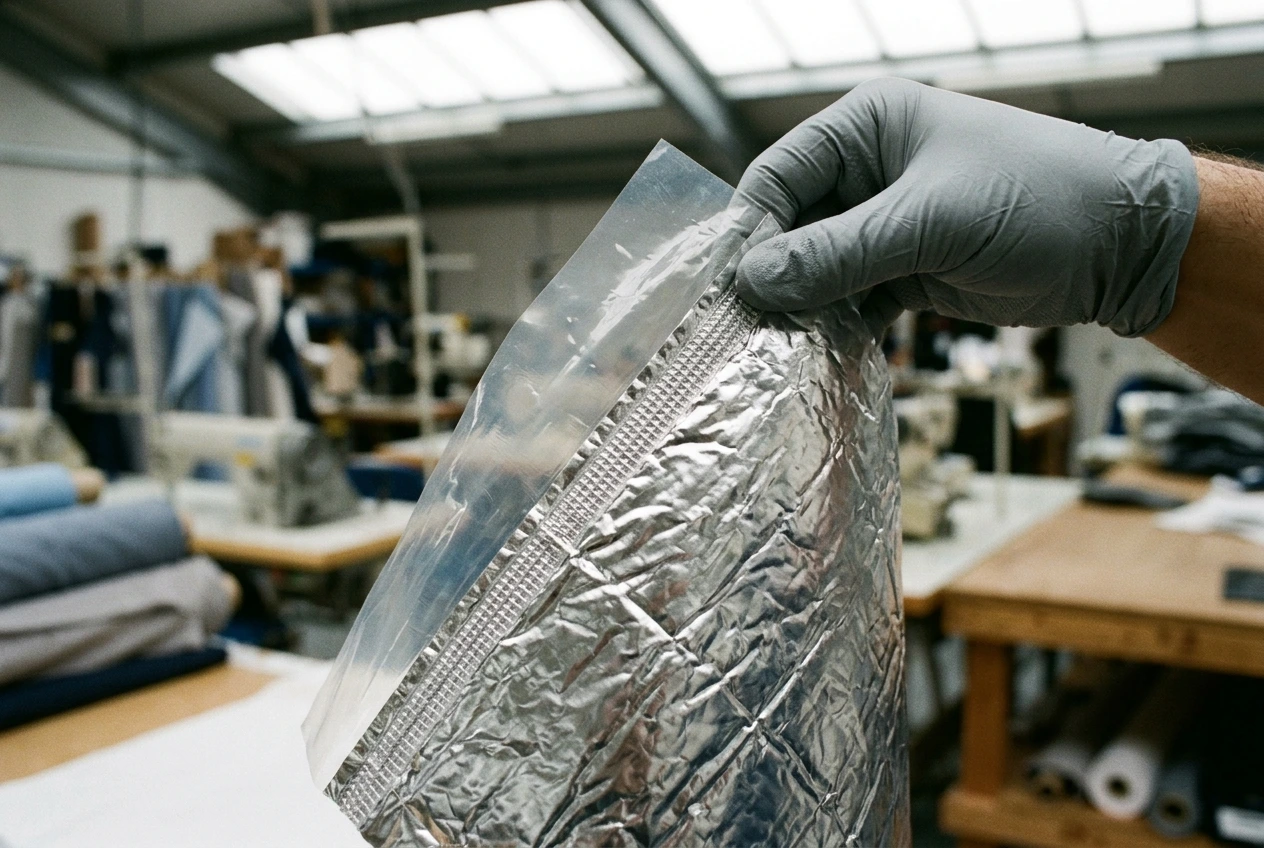
When integrating insulated packaging machinery and industrial plastic bag sealer machines into a dry ice fulfillment line, packaging engineers confront a strict dual-sealing paradox: the primary food-contact pouch must be 100% hermetically sealed, whereas the outer box liner and shipping container must be positively vented. Reversing either boundary ruins the shipment or creates an explosive pressure hazard.
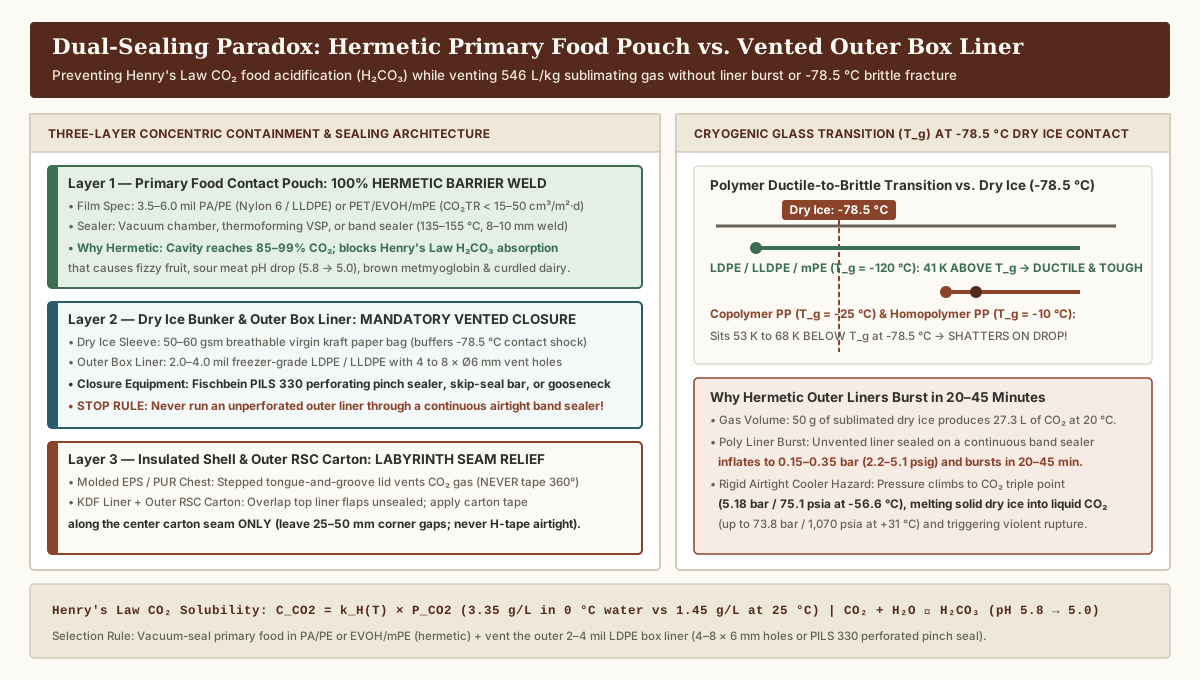
1. Triple-point pressure mechanics (5.18 bar) and why airtight outer liners burst in 20–45 minutes
Carbon dioxide’s thermodynamic triple point occurs at P_tp = 5.18 bar (518 kPa / 75.1 psia / 60.4 psig) and T_tp = -56.6 °C (-69.8 °F):
- Flexible Poly Box Liner Rupture (
0.15 to 0.35 bar/2.2 to 5.1 psigin20–45 min): Suppose a fulfillment operator loads3.6 kg(8.0 lb) of dry ice inside a 1-piece bottom-gusseted polyethylene box liner (having ~10 L of free headspace) and accidentally seals the mouth of the outer liner straight across on a continuous rotary band sealer such as the nVenia Fischbein® Model B2600 or B5000 without vent perforations. Sublimating at a normal150 g/hrate, just50 gof sublimated dry ice generates27.3 LofCO₂gas within20 minutes. The sealed polyethylene liner balloons tightly against the inner insulation walls, reaches its0.15 to 0.35 bar(2.2 to 5.1 psig) hoop-stress burst ceiling within20 to 45 minutes, blows out the heat-sealed seam, lifts the molded cooler lid, and pops the outer corrugated carton flaps open on the warehouse conveyor. - Rigid Airtight Container Explosion (
≥ 5.18 barto73.8 bar): If dry ice is locked inside a gasketed, unvented rigid plastic cooler, screw-top drum, or airtight metal canister without a pressure-relief valve, trappedCO₂gas pressurizes the vessel past5.18 bar(75.1 psia). Above the triple point, solid dry ice melts into liquidCO₂, and internal pressure climbs along the vapor-liquid saturation curve toward73.8 bar(1,070 psia) at+31.1 °C, causing a violent mechanical fragmentation explosion.
2. Three-layer concentric containment: Henry’s Law CO₂ acidification (H₂CO₃) vs. Fischbein PILS 330 liner venting
While the outer container must vent gas freely, the cold cavity inside a dry ice shipper rapidly fills with 85% to 99% gaseous CO₂ (partial pressure P_CO2 ≈ 0.85 to 0.99 atm, compared to 0.0004 atm in normal ambient air). By Henry’s Law (C_CO2 = k_H(T) × P_CO2), the solubility of carbon dioxide in water increases nearly threefold as temperature drops toward 0 °C (rising from 1.45 g/L at +25 °C to 3.35 g/L at 0 °C at 1 atm CO₂). Dissolved CO₂ reacts reversibly with water in food tissues (CO₂ + H₂O ⇌ H₂CO₃ ⇌ H⁺ + HCO₃⁻) to form carbonic acid (H₂CO₃).
If frozen or crust-frozen food is packed in unsealed fold-over bags, perforated film, or damaged welds (as addressed by Hualian Machinery Group and PFM Packaging Machinery’s frozen food barrier solutions), high-concentration CO₂ gas diffuses into the food surface and causes three severe quality failures upon thawing:
- Carbonated, Fizzy Fruit, Berries, and Bakery Fillings: High-moisture fruits, berries, and thawed dessert toppings absorb dissolved
CO₂gas and taste effervescent and sour on the palate. - Surface pH Drop (
pH 5.8 → 5.0) and Brown Metmyoglobin Discoloration in Meat and Seafood: Carbonic acid lowers the surface pH of raw beef, pork, poultry, and tuna steaks by0.5 to 0.8 pH units, accelerating oxymyoglobin oxidation into unappealing brown/gray metmyoglobin and increasing drip purge loss. - Casein Curdling and Chalky Texture in Dairy and Ice Cream: Acidification destabilizes dairy emulsions in premium ice cream, gelato, soft cheeses, and cream sauces.
To prevent both CO₂ food carbonation and package pressure rupture, specify each concentric layer’s polymer and sealing equipment independently:
| Concentric Packout Layer | Polymer Film / Material Specification | Target Sealing or Closure Equipment | Venting vs. Barrier Mandate & Physical Mechanism |
|---|---|---|---|
| Layer 1: Primary Food Contact Pouch (Individual steak, seafood fillet, berry pack, or meal tray) |
3.5 – 6.0 mil (90 – 150 µm) Coextruded PA/PE (Nylon 6 / LLDPE) or PET / EVOH / mPE high-barrier laminate (CO₂TR < 15–50 cm³/(m²·24h·atm)) |
100% Hermetic Weld: Rotary vacuum chamber, thermoforming VSP (Hualian / PFM), or continuous PTFE band sealer (Fischbein® B2600, 135–155 °C, 8–10 mm weld) |
100% Gas-Tight Hermetic Barrier Required. Blocks 85%–99% cavity CO₂ from diffusing into food water and forming carbonic acid (H₂CO₃); prevents -78.5 °C dry-air sublimation freezer burn |
| Layer 2A: Dry Ice Top Bunker Sleeve (Direct wrap around solid CO₂ block or pellets) |
50 – 60 gsm Unbleached Virgin Kraft Paper Bag or breathable spunbond polyolefin (Tyvek®) pouch (never airtight poly) |
Unsealed Fold-Over Top or loose sewing/staple closure (loaded via All-Fill VF100e for pellets) |
100% Breathable Porous Wall Required. Stabilizes the cold boundary layer (slowing slab sublimation by ~8%–12%) while venting 546 L/kg CO₂ vapor through paper pores and buffering -78.5 °C contact shock |
| Layer 2B: Outer Insulated Box Liner Bag (Enclosing entire payload inside KDF liner; see gusseted vs. die-cut liners) |
2.0 – 4.0 mil (50 – 100 µm) Freezer-Grade LDPE / LLDPE (T_g = -120 °C) pre-punched with 4 to 8 × Ø6 mm (1/4 in.) vent holes near upper mouth |
Vented Closure Only: nVenia Fischbein® PILS 330 perforating pinch sealer, intermittent skip-seal jaw (25 mm unsealed gaps), loose gooseneck fold, or single center spot-tape tab |
Mandatory Gas-Venting Relief (ΔP < 0.01 bar). Releases 5–15 L/h of sublimating CO₂ gas into the insulated wall seams; NEVER apply a continuous airtight band seal across an unperforated outer box liner |
| Layer 3: Insulated Wall & Outer RSC Carton (Molded EPS/PUR chest or KDF liner + corrugated box; see liner converting) |
Molded 1.5–2.0 in. EPS/PUR chest with stepped ship-lap lid OR 2-piece KDF paper/starch liner inside single/double-wall ECT 44 RSC carton |
Non-Airtight Carton Closure: Leave EPS lid seam 100% untaped; tape outer RSC carton along the center seam only (leave 25–50 mm corner relief gaps) |
Controlled Labyrinth Seam Venting. Allows heavy CO₂ vapor to bleed out through stepped lid notches and carton flap corners without letting warm ambient air convect directly into the cavity (never H-tape all 6 seams airtight) |
3. Cryogenic polymer glass transition (T_g) at -78.5 °C: ductile LDPE/LLDPE vs. brittle PP shattering
As documented in Wolf-Packing Machine Company’s automated bagging material compatibility guide and our industrial plastic bag sealer machine reference, selecting the wrong polyolefin resin for bags that contact -78.5 °C (-109.3 °F) dry ice causes catastrophic brittle fracture during parcel sortation drops (check incoming rollstock web tension and pin-perforation registration per our slitting and rewinding machine guide):
- Homopolymer & Copolymer Polypropylene (
PP / BOPP / CPP) andPLAShatter BelowT_g:- Isotactic Homopolymer Polypropylene (
PP / BOPP / CPP): Exhibits a glass transition temperature ofT_g ≈ -10 °C to 0 °C(+14 °F to +32 °F) (and a narrow heat-seal window near 123 °C to 162 °C). Even impact-modified ethylene-propylene block copolymerPPlowersT_gonly to-25 °C to -30 °C, while biopolymer polylactic acid (PLA) hasT_g ≈ +55 °C to +60 °C. - Failure Mechanism at
-78.5 °C: Inside a dry ice shipper, polypropylene film sits50 K to 70 Kbelow its glass transition temperature. Amorphous polymer chains freeze into a rigid glassy state with near-zero elongation at break (< 3%), causingPPpouches and wovenPPliners to shatter like glass panes under a standard450 mm(18 in.) parcel conveyor drop.
- Isotactic Homopolymer Polypropylene (
- Low-Density, Linear Low-Density & Metallocene Polyethylene (
LDPE / LLDPE / mPE) Stay Ductile (T_g ≈ -120 °C):- Polyethylene (
LDPE,C6/C8 LLDPE, andMetallocene mPE): Exhibits a cryogenic glass transition temperature ofT_g ≈ -110 °C to -125 °C(-166 °F to -193 °F) and a wide, forgiving120 °C to 160 °C(248 °F to 320 °F) heat-sealing window across2.0 to 6.0 mil(50 to 152 µm) gauges. - Why
LLDPE / mPESurvives Dry Ice: Even in direct contact with a-78.5 °CsolidCO₂slab,LDPEandLLDPEremain30 K to 45 Kabove their glass transition temperature, preserving ductile chain mobility and high puncture resistance (specify 4.0 to 6.0 mil PA/LLDPE or PA/mPE for bone-in meats and heavy frozen seafood).
- Polyethylene (
Selection Takeaway: Enforce the dual-sealing rule on every dry ice packing line: vacuum-seal primary food pouches hermetically (
8–10 mmweld at135–155 °Cin3.5–6.0 milPA/PEorPET/EVOH/mPE) to prevent Henry’s Law carbonic acid (H₂CO₃) spoilage, specify2.0–4.0 milfreezer-gradeLDPE/LLDPE(T_g = -120 °C, never brittlePPwithT_g = -10 °C) for the outer box liner, and vent the outer liner (4–8 × 6 mmpunch holes or aFischbein PILS 330perforating pinch closure) plus the outer carton (center-seam tape only, never H-taped airtight).
Comply with UN 1845 dry ice packaging requirements: IATA Packing Instruction 954 and 49 CFR § 173.217
Under international aviation law (ICAO Technical Instructions and the IATA Dangerous Goods Regulations) and United States Department of Transportation hazardous materials regulations (49 CFR § 173.217), solid carbon dioxide is regulated as UN 1845, Proper Shipping Name "Dry ice" or "Carbon dioxide, solid", Hazard Class 9 (Miscellaneous Dangerous Goods), with Packing Group: None (N/A).
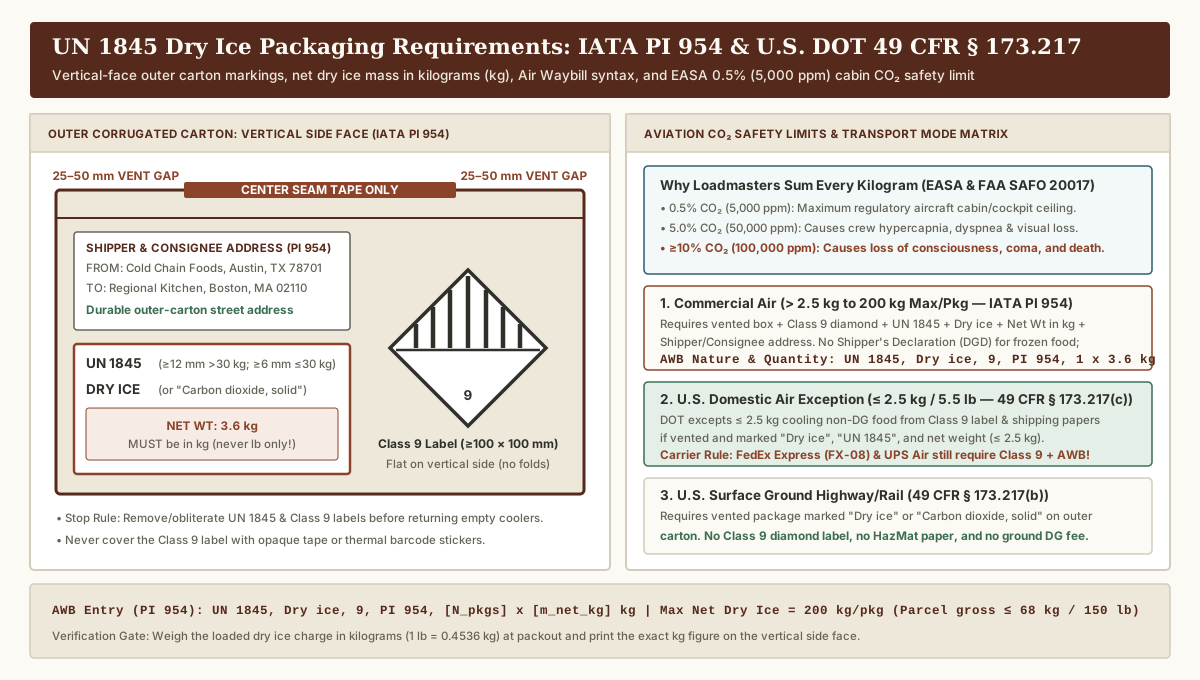
1. Aviation safety physics: EASA 0.5% (5,000 ppm) cabin CO₂ limits and cargo hold outgassing
The strict enforcement of un1845 dry ice packaging requirements by express air carriers is driven by flight-crew asphyxiation physics documented in European Union Aviation Safety Agency (EASA) and U.S. Federal Aviation Administration (FAA SAFO 20017) guidance on transporting dry ice by air and Pharmaceutical Commerce’s engineering investigation of FedEx Express Boeing 777-F dry ice outgassing limits:
- Human Physiological
CO₂Toxicity Thresholds vs. The0.5%Aviation Ceiling (EASA / FAA): Normal outdoor air contains~0.04%(400 ppm)CO₂. UnderFAA 14 CFR § 25.831andEASA CS 25.831, the maximum allowableCO₂concentration in an aircraft cockpit and cabin is0.5%by volume (5,000 ppmSea Level Equivalent). When sublimating dry ice raises compartmentCO₂concentration to~5%(50,000 ppm), flight crews suffer hypercapnia (shortness of breath, headache, dizziness, visual dimness, and impaired cognitive judgment). At≥ 10%(100,000 ppm), gaseousCO₂triggers rapid loss of consciousness, convulsions, coma, and death by asphyxiation. - Why Modern Freighters (
Boeing 777-F) Strictly Audit Kilogram (kg) Declarations: As Pharmaceutical Commerce reports regarding FedEx Express’s long-range Boeing 777-F freighter fleet, modern fuel-efficient cargo aircraft feature tighter fuselage seals and reduced engine bleed-air ventilation into insulated lower-deck cargo holds compared to legacy tri-jets (DC-10 / MD-11). Consequently, airline loadmasters and automated ramp systems sum the marked net weight of dry ice in kilograms (kg) on everyUN 1845parcel against aircraft-specificFAAsublimation-rate formulas (typically assuming 1% to 2% hourly loss during flight) before clearing a Unit Load Device (ULD) onto the aircraft.
2. Six mandatory IATA Packing Instruction 954 (PI 954) air parcel requirements
When shipping frozen food (a non-dangerous good) cooled by dry ice via commercial air freight or express air parcel (FedEx Express, UPS Air, DHL Express), IATA DGR Packing Instruction 954 (PI 954) and Sonoco ThermoSafe’s UN 1845 compliance guidelines mandate six physical and documentary elements:
- Gas-Venting, Cryogenic-Resistant Outer Packaging:
The package must be designed and constructed to permit the continuous release of carbon dioxide gas to prevent internal pressure buildup that could rupture the packaging, and must use materials resistant to low-temperature embrittlement (
corrugated fiberboard outer RSC carton housing a molded EPS, PUR, VIP, or KDF insulated liner; UN specification performance-tested drums/boxes are NOT required under PI 954). - Maximum Net Quantity per Package (
200 kgAir Limit): UnderIATA PI 954, the maximum net mass of solid dry ice per individual package is200 kg(440 lb) on both Passenger and Cargo aircraft (note that small-parcel express carriers cap non-palletized parcel gross weight at 68 kg / 150 lb). Class 9 Miscellaneous Dangerous GoodsDiamond Hazard Label (≥ 100 × 100 mm): Affix a standard Class 9 hazard diamond (minimum100 × 100 mm/3.94 × 3.94 in.square-on-point, displaying7black vertical stripes in the upper half and an underlined"9"at the bottom corner) flat on a vertical side surface of the outer corrugated carton. Never fold the Class 9 diamond around a carton corner edge, never place it on the bottom of the box, and never cover it with thermal barcode stickers or opaque/tinted strapping tape.- Outer Carton Markings on the Same Vertical Face (
Net Weight in Kilograms Is Mandatory): Print durably and legibly on the same vertical side face adjacent to the Class 9 diamond:- UN Identification Number:
UN 1845(minimum character height ≥ 12 mm / 0.47 in. for packages > 30 kg gross weight, or ≥ 6 mm / 0.24 in. for packages ≤ 30 kg gross weight), - Proper Shipping Name:
Dry iceorCarbon dioxide, solid, and - Net Weight of Dry Ice in Kilograms (
kg) at Packout: e.g.,Net Wt. 3.6 kg(or "3.6 kg Net Wt."). Critical Rejection Trap: Aviation dangerous-goods regulations operate strictly in metric SI units. Writing the net dry ice weight only in pounds (e.g., "8 lb") triggers an automatic dangerous-goods rejection at the carrier air ramp (you may print "Net Wt. 3.6 kg (8.0 lb)" with kg primary, rounded to 1 decimal place).
- UN Identification Number:
- Shipper and Consignee Full Name and Street Address:
The full name and physical street address of both the Shipper and the Consignee must be durably marked directly on the outer carton (
or on an adjacent permanent address label on the same vertical face). - Air Waybill (
AWB) Statement vs. Shipper’s Declaration (DGD) Exemption: WhenUN 1845dry ice is used strictly as a refrigerant for non-dangerous goods (such as frozen food), a formal red-bordered Shipper’s Declaration for Dangerous Goods (DGD) is NOT required. Instead, the Air Waybill (AWB)"Nature and Quantity of Goods"box (or electronic carrier DG manifest) must contain the exact five-part string:
UN 1845, Dry ice, 9, PI 954, [Number of packages] x [Net weight of dry ice per package in kg] kg

Example (single parcel with 3.6 kg of dry ice):
UN 1845, Dry ice, 9, PI 954, 1 x 3.6 kg

Example (three identical parcels each containing 4.0 kg of dry ice):
UN 1845, Dry ice, 9, PI 954, 3 x 4.0 kg
3. Regulatory mode comparison: IATA PI 954 Air vs. U.S. DOT 49 CFR § 173.217 Ground & ≤ 2.5 kg Exceptions
Compliance requirements change substantially between commercial air freight (IATA PI 954 / 49 CFR § 173.217(a)), the ≤ 2.5 kg (5.5 lb) U.S. domestic air exception (49 CFR § 173.217(c)), and pure surface highway ground parcel networks (UPS Ground / FedEx Ground under 49 CFR § 173.217(b)):
| Transport Mode & Regulatory Authority | Net Dry Ice Mass Ceiling per Package | Mandatory Outer Carton Markings | Class 9 Diamond Label (100 × 100 mm) |
Shipping Paper / AWB Statement & Carrier Surcharge |
|---|---|---|---|---|
| 1. Commercial Air Freight & Express Air Parcel ( IATA DGR PI 954, ICAO TI, & 49 CFR § 173.217(a)–(c) for > 2.5 kg) |
200 kg (440 lb) max per package (carrier non-freight parcel gross limit: 68 kg / 150 lb) |
• UN 1845 (≥ 6–12 mm)• Dry ice or Carbon dioxide, solid• Net weight in kg (e.g., 3.6 kg)• Shipper & Consignee name/address |
REQUIRED on vertical side face (never folded over edges) |
No DGD required for frozen food; Air Waybill (AWB) must state:UN 1845, Dry ice, 9, PI 954, N x X.X kg(Incurs carrier air Dry Ice DG fee) |
| 2. U.S. Domestic Air Small-Quantity Exception ( 49 CFR § 173.217(c) for cooling non-DG food or diagnostic/medical contents) |
≤ 2.5 kg (5.5 lb) net dry ice per package (subject to aircraft hold limits) |
• Dry ice or Carbon dioxide, solid• UN 1845• Net weight of dry ice ( ≤ 2.5 kg) |
Exempt under statutory DOT rule, BUT required by FedEx Express (FX-08) & UPS Air on commercial food parcels! |
Statutory DOT rule exempts from shipping papers, but FedEx Express / UPS Air still require the Class 9 label and electronic AWB dry-ice check for commercial shippers |
| 3. U.S. Domestic Surface Ground Highway / Rail ( 49 CFR § 173.217(b) for UPS Ground / FedEx Ground / Regional Ground) |
No statutory 2.5 kg cap (limited by carrier 68 kg / 150 lb gross parcel weight & trailer ventilation) |
• Dry ice or Carbon dioxide, solid marked visibly on outer carton (adding net weight is best practice) |
NOT REQUIRED for pure surface highway/rail transport | No HazMat shipping paper, no Class 9 diamond, and no ground Dangerous Goods fee (never tender a ground-only unmarked box to an air service!) |
| 4. Passenger Aircraft Carry-On / Checked Baggage ( 49 CFR § 175.10(a)(10) & IATA DGR Table 2.3.A) |
≤ 2.5 kg (5.5 lb) net dry ice per passenger (cooling perishable food) |
• Dry ice or Carbon dioxide, solid• Net weight ( ≤ 2.5 kg) (plus airline baggage tag) |
Not required on accompanied passenger baggage (airline tag applied) |
Requires prior airline operator approval at check-in; package must vent CO₂ gas freely |
Selection Takeaway: For any commercial air frozen food parcel (
FedEx Express,UPS Air,DHL), always affix the100 × 100 mmClass 9 diamond flat on a vertical carton face, printUN 1845,Dry ice, and the net dry ice mass in kilograms (kg, neverlbonly) on that same vertical face, and populate the Air Waybill withUN 1845, Dry ice, 9, PI 954, [N] x [kg] kg. When routing within24–48 hregional zones via surface ground (49 CFR § 173.217(b)), mark the vented carton"Dry ice"or"Carbon dioxide, solid"to eliminate air Dangerous Goods surcharges, or engineer the enclosure (1.5 in.EPS at24 h,1.5 in.PUR at48 h, or1.0 in.VIP up to96 h) to stay at or below2.5 kg(5.5 lb) of dry ice.
Run a four-gate dry ice packout and dangerous-goods inspection before carrier handoff
Before releasing a frozen food dry ice shipment from the packing station (and after verifying inner cavity clearances against our insulated shipping boxes dimension worksheet), execute this four-gate quality and regulatory inspection sequence:
| Verification Gate | Engineering & Regulatory Parameter to Record | Acceptance Threshold & Mandatory Stop Rule |
|---|---|---|
Gate 1: Pre-Frozen Payload (≤ -20 °C), Top-Down Layering & Void Dunnage |
Record incoming food core temperature (T_food,in via calibrated probe), dry ice physical format (compressed slab vs. 5/8 in. nuggets vs. 3/8 in. pellets), top-down placement above a 6–10 mm corrugated buffer pad, and kraft paper void fill (Sonoco ThermoSafe). |
Stop Rule: Reject any food lot warmer than -15 °C (+5 °F) (never use transit dry ice to freeze warm product). Reject any packout where dry ice is placed solely on the bottom floor or where empty headspace voids are left unstuffed (warm air pockets accelerate sublimation by 20%–35%). |
| Gate 2: Dual-Sealing Check (Hermetic Primary Food Pouch vs. Vented Outer Liner) | Inspect primary food pouches (3.5–6.0 mil PA/PE or PET/EVOH/mPE vacuum/band weld, 8–10 mm width per bag sealer guide) and outer box liner (50–60 gsm kraft dry-ice sleeve + 2–4 mil LDPE/LLDPE liner with 4–8 × 6 mm vent holes or Fischbein PILS 330 perforated pinch closure). |
Stop Rule: Reject unsealed or leaking primary food bags (which suffer Henry's Law H₂CO₃ carbonation and meat browning). STOP IMMEDIATELY if an outer poly box liner is hermetically band-sealed across its full width without vent holes or is made from homopolymer PP (T_g ≈ -10 °C), which shatters at -78.5 °C. |
| Gate 3: Stepped EPS Lid Channels & Non-Airtight Outer Carton Taping | Inspect the insulated enclosure top joint (stepped tongue-and-groove molded EPS/PUR lid or overlapped 2-piece die-cut / 1-piece gusseted liner flaps) and the outer RSC corrugated carton tape pattern. |
Stop Rule: Reject any molded EPS cooler whose lid-to-base perimeter seam is wrapped 360° with tape, and reject any outer corrugated carton H-taped airtight across all 6 seams. Apply carton tape along the center seam only, leaving 25–50 mm (1–2 in.) untaped corner relief gaps. |
Gate 4: UN 1845 / IATA PI 954 Vertical Side Labeling & Net Weight in kg |
Verify vertical-side outer carton compliance: 100 × 100 mm Class 9 diamond, UN 1845 (≥ 6 mm for ≤ 30 kg; ≥ 12 mm for > 30 kg), "Dry ice" or "Carbon dioxide, solid", net dry ice mass in kg, Shipper/Consignee street addresses, and AWB string UN 1845, Dry ice, 9, PI 954, N x X.X kg. |
Stop Rule: Reject any air parcel whose net dry ice weight is marked in pounds (lb) only, whose Class 9 label is folded over a box edge or covered by opaque tape, or any empty return reusable VIP/EPS shipper that still displays unobliterated UN 1845 / Class 9 markings (strictly prohibited by IATA & DOT). |
Selection Takeaway: Treat thermal hold, mechanical gas relief, and dangerous-goods compliance as a single release checklist: verify a
≤ -20 °Cpre-frozen payload, confirm hermeticPA/PEprimary food pouches inside a ventedLDPEouter liner, leave outer carton corners untaped for gas relief, and print the exact packout dry ice net weight in kilograms (kg) alongside the verticalUN 1845andClass 9markings.
Technical basis and scope
Sublimation thermodynamics (T_sub = -78.5 °C, ΔH_sub = 571.3 kJ/kg, and 852× volumetric gas expansion at 20 °C), dry-ice geometry kinetics (compressed slabs vs. extruded nuggets and pellets), polymer glass transition boundaries (LDPE/LLDPE T_g ≈ -120 °C vs. PP T_g ≈ -10 °C), and dangerous-goods transport rules in this guide are grounded in published technical documentation and regulatory standards from Sonoco ThermoSafe® (2025 Dry Ice Market & Sublimation Analysis and UN 1845 FAQ), Packaging Europe / Peli BioThermal™ (Sherpa™ DeepFreeze molded EPS and Crēdo™ Cube VIP dry-ice shippers), the International Institute of Refrigeration (IIR / IIFIIR) and Oak Ridge National Laboratory ultra-low-temperature CFD studies, the European Union Aviation Safety Agency (EASA) and U.S. Federal Aviation Administration (FAA SAFO 20017 guidance on UN 1845 aircraft cabin 0.5% CO₂ concentration limits), Pharmaceutical Commerce (air carrier B777-F cargo hold dry-ice outgassing limits), nVenia (Fischbein® Model B2600/B5000 continuous band sealers and PILS 330 perforating pinch inner liner sealers), Wolf-Packing Machine Company (LDPE/LLDPE vs. PP bagging material compatibility), and Hualian Machinery Group / PFM Packaging Machinery / All-Fill Inc. (frozen food vacuum barrier packaging and VF100e vibratory dry-ice dosing), alongside IATA Dangerous Goods Regulations Packing Instruction 954 (PI 954) and U.S. DOT 49 CFR § 173.217. Whole-box sublimation sizing matrices (12 × 10 × 10 in. cavity across 24–96 h) represent engineering planning models governed by derated enclosure conductance (UA_box), ambient lane temperature profiles, and dry-ice density; always qualify final production packouts through calibrated chamber and transit lane testing and verify carrier-specific dangerous-goods variations before shipping (see our editorial policy).