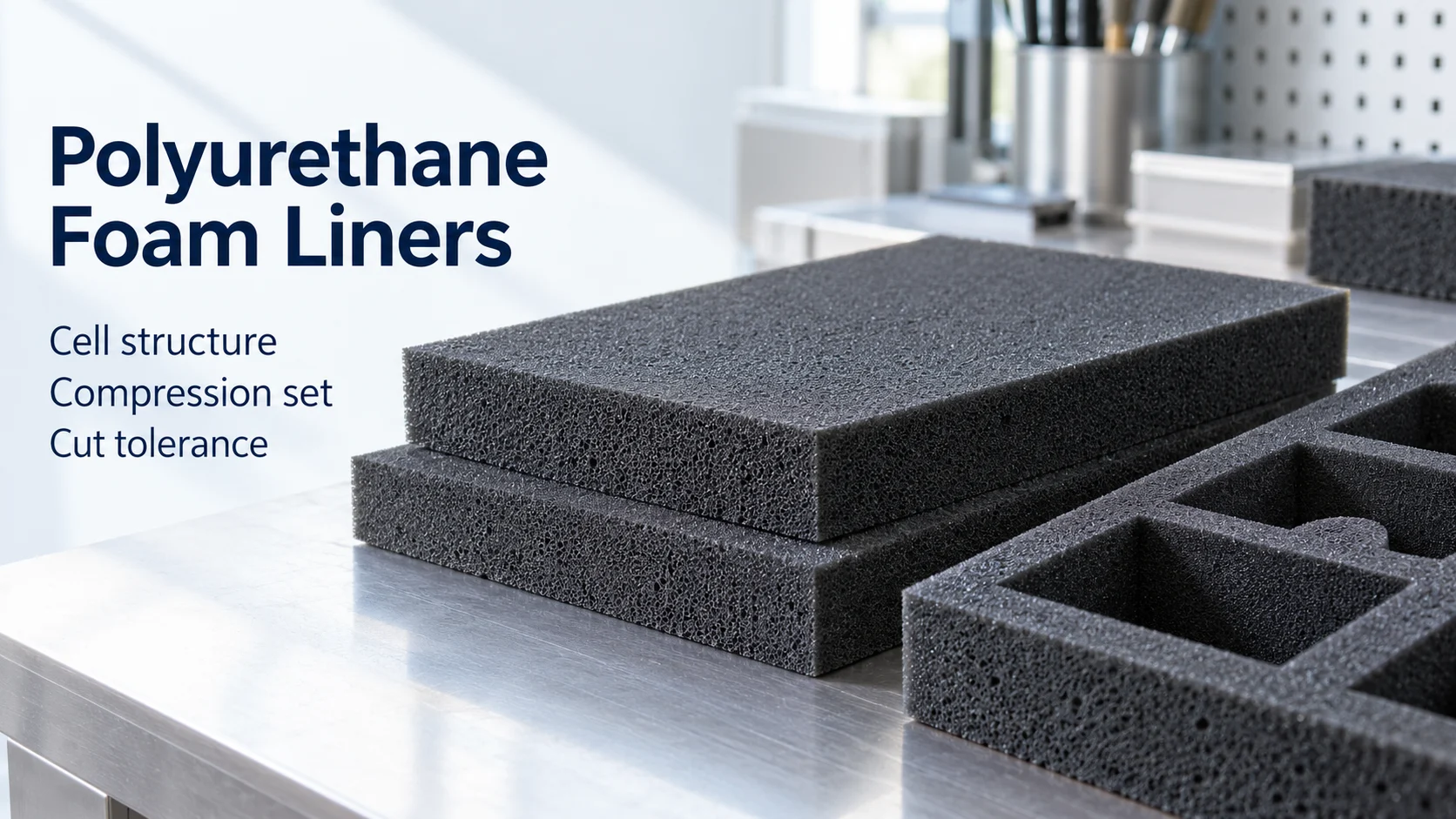
Specify a polyurethane foam liner by working through material identity, compression behaviour and cut-part inspection. Put the selected grade, test conditions and drawing requirements together before releasing the part for production.
Foams of the same density can vary considerably in mechanical properties.
Start with the liner converting guide for the broader material-to-assembly handoff. Use the checklist below to prepare the foam-specific discussion.
Closed cell vs open cell polyurethane foam
In flexible polyurethane foam, closed cells have intact membranes that reduce or eliminate airflow passageways. Open-cell structure permits gases or liquids to pass freely through flexible foam.
Ask for the named foam grade and its cell-structure report. Keep the report method, specimen preparation, result and agreed acceptance requirement together. When requesting a closed-cell ratio, ask which material family the method covers and how the result is reported.
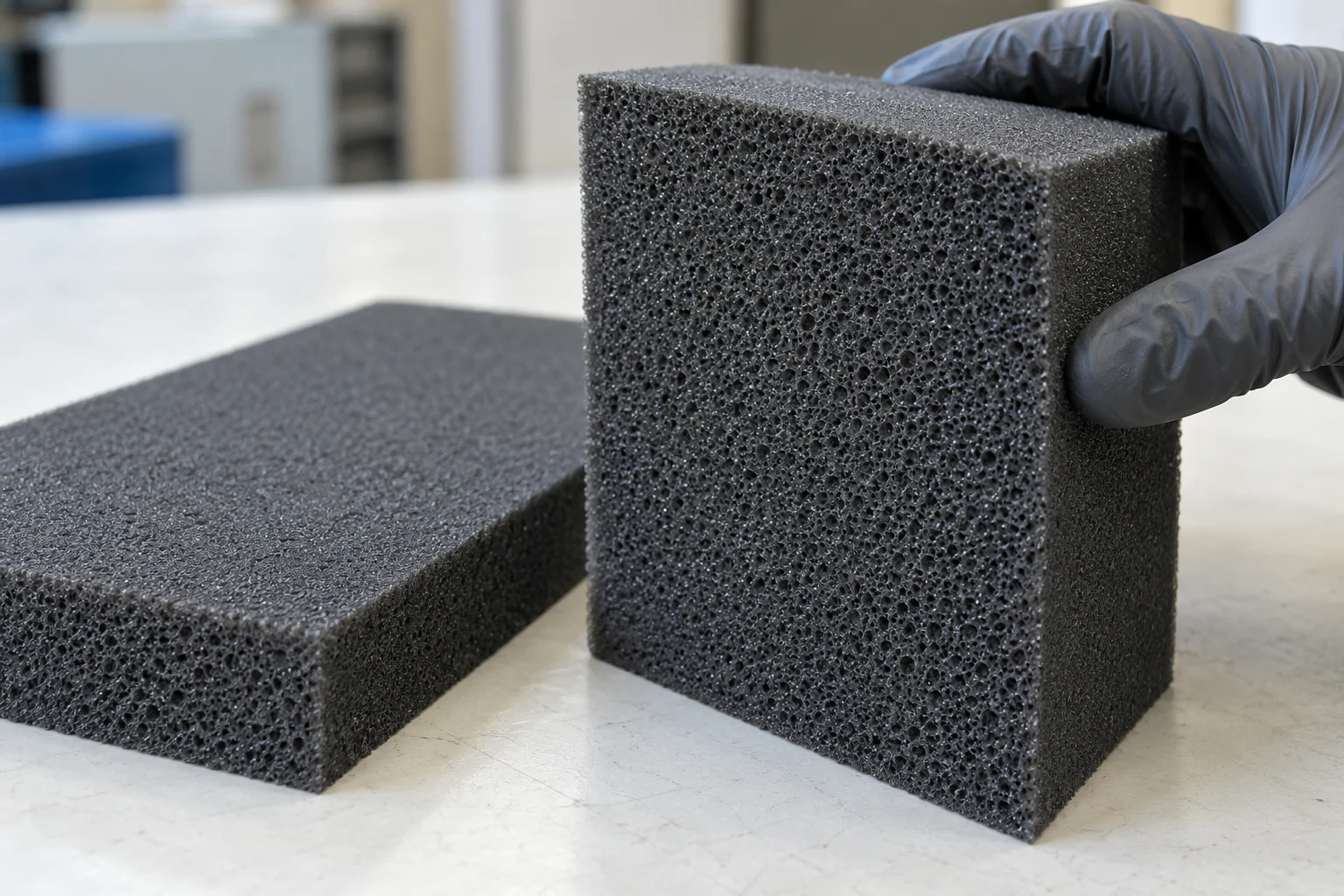
Read the cell-content report
For rigid cellular plastics, consider the ASTM test method for open-cell content when reviewing the report.
The ASTM open-cell-content method for rigid cellular plastics determines numerical values for open cells. The porosity determination measures accessible cellular volume. The remaining volume is occupied by closed cells and cell walls. Cutting a specimen opens some closed cells, which are included as open cells. Uncorrected specimen-opening effects reduce accuracy as closed-cell content and cell size increase.
Request the specimen preparation and correction details alongside the reported result. Keep that request separate from the drawing’s cut dimensions and compression acceptance criteria.
Packaging foam compression set: what to compare
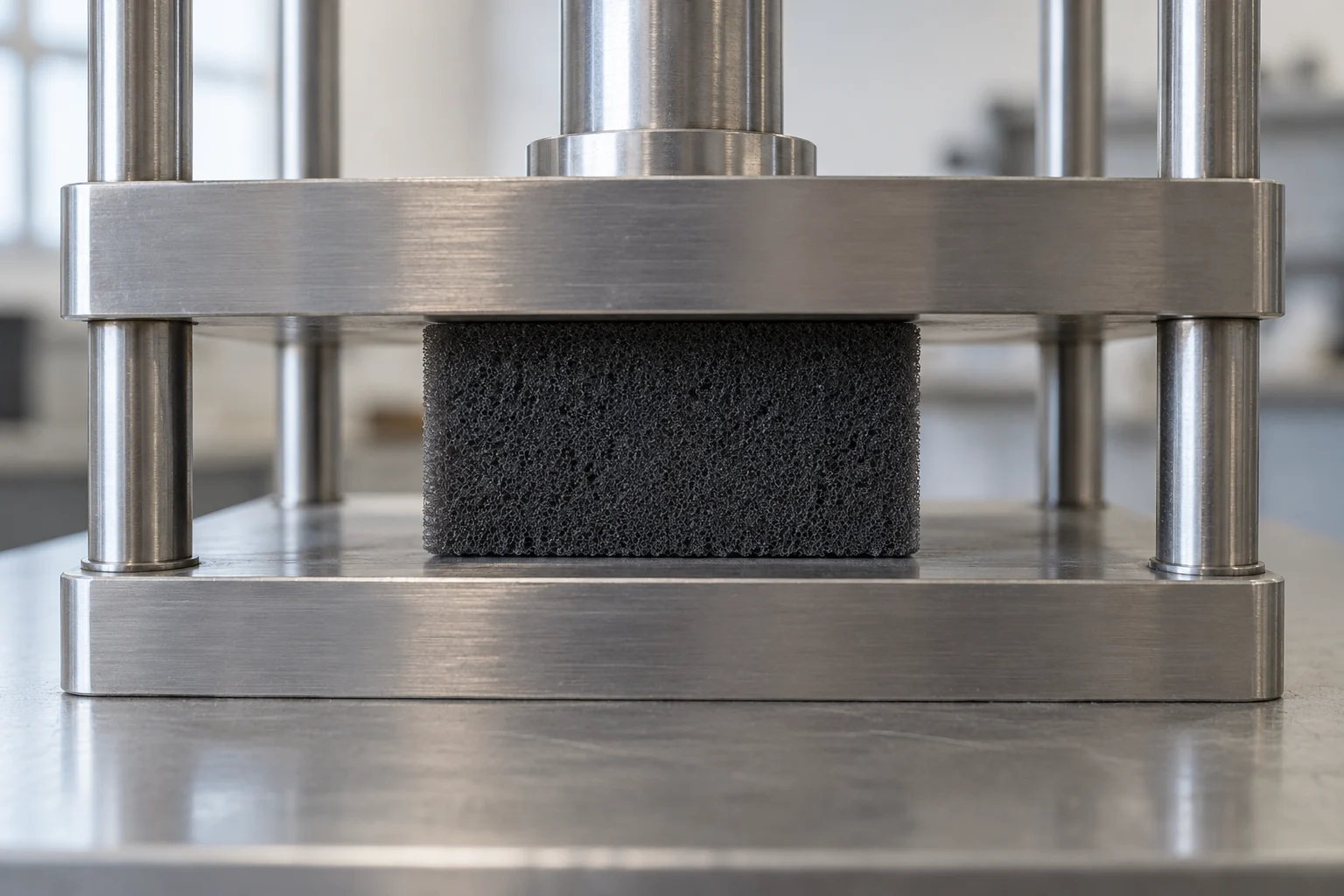
For flexible polyurethane foam, compression set is permanent loss of initial foam height after compression. Compression set is most commonly expressed as a percent of original height.
Compression force deflection measures stress needed to compress a foam block to a specified deflection. Creep testing measures thickness change over time under constant loading weight.
Organize the material review around distinct questions:
- How much stress is needed at the selected deflection? Request the compression force deflection result and its conditions.
- How much height remains lost after release? Request the compression-set result and recovery conditions.
- What happens during sustained loading? Request the creep result for the intended loading discussion.
Preserve the test conditions
The Polyurethane Foam Association compression-set overview specifies 22 hours under compression. In that compression-set overview, samples are allowed to recover for 30 minutes.
On the material comparison sheet, record the method and edition, specimen construction, compression condition, temperature, duration and recovery interval for each result. Carry the selected material’s own test conditions into the comparison.
For ASTM flexible polyurethane foam testing, test results apply to the material under the particular test conditions.
Clarify what “crushed” means
For high resilience slabstock or molded flexible polyurethane foam, crushing can be a conditioning process to open closed cells.
When documenting a rejected liner, describe the observed condition: retained height loss, a recessed cut edge, or an installation-fit issue. Attach the corresponding material report or drawing inspection result.
Die cut foam liner tolerances: inspect the edge
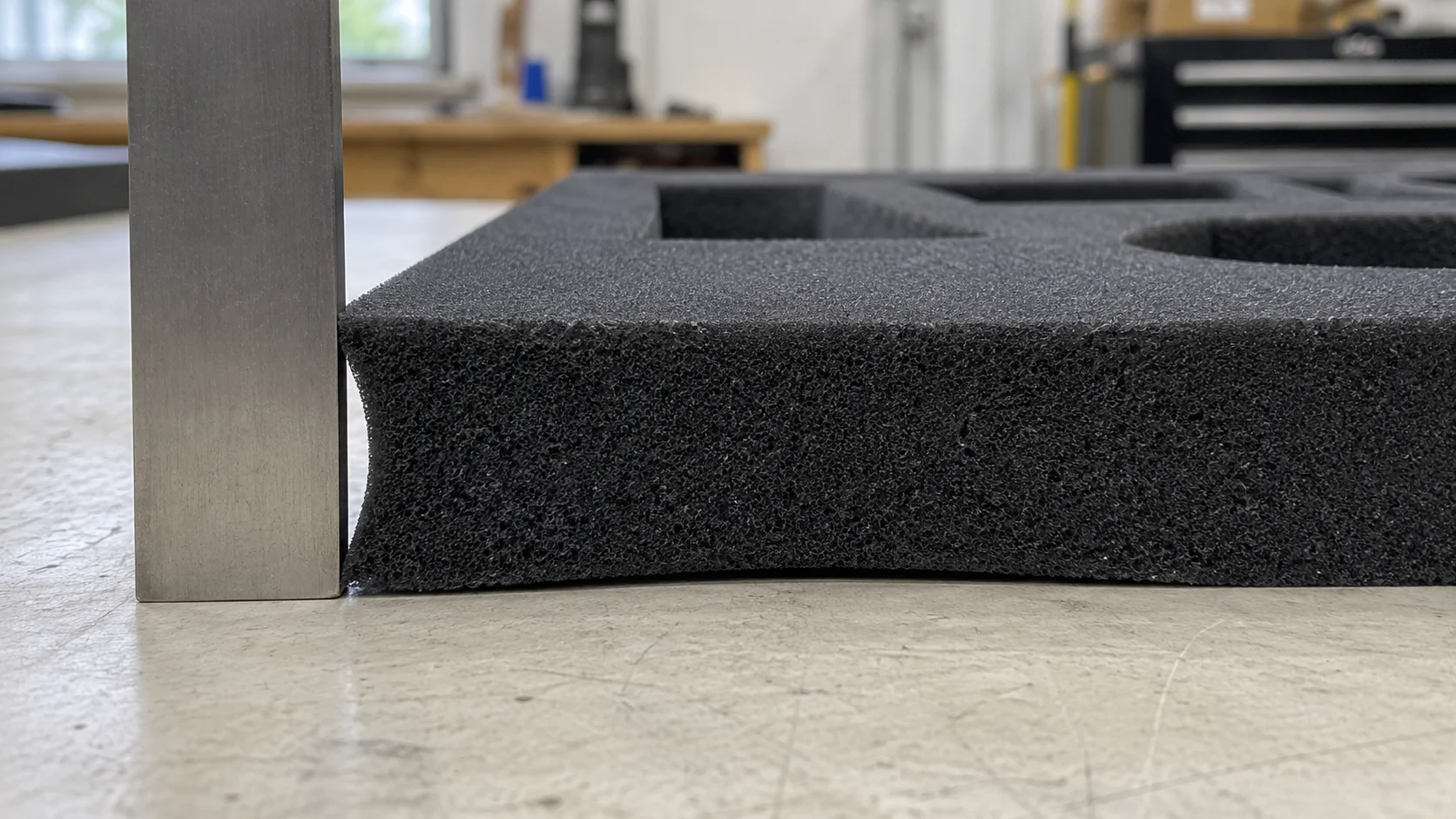
Compression during diecutting can produce edge concavity when pressure is released. Die-cut sidewall concavity is governed by four material and tooling factors: foam density, foam thickness, cutting rule type, and cutting rule height.
For the cut-part drawing, identify the inspection face and measurement location. Include a separate edge-profile acceptance field for the recessed edge. Ask the converter to return the proposed limits with the sampled part and inspection method.
Material thickness and the inspection datum
For PORON materials, thickness tolerances are listed on individual product data sheets. For PORON supported materials, the permanent standard liner is included in the stated foam thickness. For PORON supported materials, the removable release liner is excluded from stated thickness.
In the selected construction’s drawing, explicitly identify what the thickness measurement includes. Record the free material thickness, installed gap and cut dimensions as separate fields. Ask for the applicable data sheet with the proposed construction.
Drawing handoff checklist
Use the following prompts when preparing the supplier discussion.
| Drawing or report field | What to request |
|---|---|
| Material identity | Exact grade, construction and cell-structure report. |
| Free material thickness | Nominal value, tolerance, included layers and measurement method. |
| Installed condition | Gap, intended compression and closing-force requirement. |
| Cut geometry | Critical outside and cavity dimensions, inspection face and measurement locations. |
| Edge profile | Concavity acceptance requirement and inspection method. |
| Compression report | Method, specimen, loading, temperature, duration, recovery and acceptance limit. |
Apply tolerances to critical dimensions only. Specify measurement location and method for complex geometries. Verify tolerance stack-ups across multi-part assemblies against functional requirements.
Take the completed drawing into the cutting, forming and assembly handoff. For the carton interface, continue with the insulated shipping box fit worksheet.
Sources
- Polyurethane Foam Association — Glossary
- Polyurethane Foam Association — InTouch: Foam Performance Testing
- ASTM International — Standard Test Method for Open Cell Content of Rigid Cellular Plastics
- ASTM International — Standard Test Methods for Flexible Cellular Materials—Slab, Bonded, and Molded Urethane Foams
- General Plastics — Why Use Polyurethane Foam
- Willard Packaging — Diecutting and Concavity
- Rogers Corporation — PORON Product Availability Booklet
- Colvin Friedman — Die Cutting Tolerances Guide